October 31, 2012

Remembering Ray Bradbury

He wrote the novel whose title evokes for everyone the nightmare it would be to live in a world which has banned all books, and his favourite holiday was Hallowe’en. So October is a good time to remember Ray Bradbury, who died this year at the age of 91, by passing on a letter he wrote to an American librarian about composing that very novel, Fahrenheit 451, in the basement of the Powell Library at UCLA.

Powell Library is that Italian Renaissance-style brick building (I can make this architectural call because it strongly resembles a Brunelleschi rotonda in Florence I remember very clearly, from having once driven my boyfriend's brand new Vespa smack into it) which you will have seen if you have ever watched a Hollywood movie with a scene which takes place at a University, no matter what state or city it is purported to be located in. In fact, I remember seeing it stand in for Berkeley just recently when The Graduate was on TV.

And this of course is perfect for Ray Bradbury, who always used to say that libraries had been his University, just as Prof. Jim Flynn says can be true for everyone in the book he presented at Auckland Libraries for last year's New Zealand Book Month, The torchlight list. The inspiration for Prof. Flynn’s book was the family story of his uncles reading by torchlight on the troopships carrying them to Europe, but it could just as well have been Ray Bradbury, who did at one point apply to attend City College in Los Angeles, but, when the only answer he could come up with when a ‘little elf’ inside him asked him why he would want to was “Girls, women and sex”, decided he wouldn’t go there after all, but devote himself straight away to being a writer.

Here's the letter he sent the Fayetteville Public Library fifty odd years later, when the book he then went and wrote was chosen for their "Big Read", about how that had gone. I came across it on a website called Letters of Note (where you can also see a scan of the actual letter), a site featuring "correspondence deserving of a wider audience (fakes will be sneered at)", and this it certainly is.

September 15, 2006
Dear Shawna Thorup:
I'm glad to hear that you good people will be celebrating my book, "Fahrenheit 451." I thought you might want to hear how the first version of it, 25,000 words and which appeared in a magazine, got done.
I needed an office and had no money for one. Then one day I was wandering around U.C.L.A. and I heard typing down below in the basement of the library. I discovered there was a typing room where you could rent a typewriter for ten cents a half hour. I moved into the typing room along with a bunch of students and my bag of dimes, which totaled $9.80, which I spent and created the 25,000 word version of "The Fireman" in nine days. How could I have written so many words so quickly? It was because of the library. All of my friends, all of my loved ones, were on the shelves above and shouted, yelled and shrieked at me to be creative. So I ran up and down the stairs, finding books and quotes to put in my "Fireman" novella. You can imagine how exciting it was to do a book about book burning in the very presence of the hundreds of my beloveds on the shelves. It was the perfect way to be creative; that's what the library does.
I hope you enjoy reading my passionate output, which became larger a few years later and became popular, thank God, with a lot of people.
I send you all my good wishes,
(Signed)

On the occasion of his 90th birthday, Bradbury wrote a longer version of this story for UCLA magazine, where you can see a photo of Powell Library, the place my sister, who went to UCLA, remembers as the best place to daydream on the whole campus.

Someone named Sam Weller, believe it or not, as if he were one of the exiles from the society which had outlawed books in Fahrenheit 451, the ones who had each memorised a book to keep it alive, and his would have been The Pickwick Papers, has written a book about Ray Bradbury called The Bradbury chronicles : the life of Ray Bradbury. I haven't read it myself, but the reviews on the library catalogue for it are good, although I need to remark on this odd line in the one from Publishers Weekly:  "If Weller places Bradbury in a pantheon occupied by Shakespeare, Melville, Dickens and Poe, he also mentions more than one extramarital affair and his hero's poor eating habits.”

Am I reading this correctly? Is this saying that extramarital affairs are in contrast with inclusion in this exalted pantheon? Shakespeare’s love life may still be anyone’s guess, but Jay Parini’s book The passages of HM convinced even dubious me of the married Melville’s "unambiguous attraction in thought and deed to men"; the married Charles Dickens’s behavior after meeting and falling in love with the actress Ellen Ternan was described by his daughter Kate like this: "He did not care a damn what happened to any of us. Nothing could surpass the misery and unhappiness of our home"; and while Edgar Allan Poe's reputation is not besmirched by marital infidelity, there is that fact that he married a 13 year old. Maybe it was more the poor eating habits which threaten to take Bradbury out of the pantheon -- you've got to watch that Campbell's tomato soup, one of his more frequent meals, as I recall.

By far my favourite works by Ray Bradbury are his short stories, which, mistakenly apprehensive that they would be too science-fictiony for me, I was only inspired to read when my daughter's Intermediate School English teacher assigned them to her class (forever grateful, Miss Chambers!). Of all the short stories my favourite is "The Fog Horn", a wondrous mixture of the mythic, the sorrowful, and the shivery, in which a sea monster is lured from the deep by the call of a Fog Horn -- I picture the long neck of an aquatic, brontosaurus-type animal rising out of the water, draped with algae.

"One day many years ago a man walked along and stood in the sound of the ocean on a cold sunless shore and said, ‘We need a voice to call across the water, to warn ships. I’ll make a voice like all of time and all of the fog that ever was. I’ll make a voice that is like an empty bed beside you all night long, and like an empty house when you open the door, and like trees in autumn with no leaves. A sound like the birds flying south, crying, and a sound like November wind and the sea on the hard, cold shore. I’ll make a sound that’s so alone that no one can miss it, that whoever hears it will weep in their souls, and hearths will seem warmer, and being inside will seem better to all who hear it in the distant towns. I’ll make me a sound and an apparatus and they’ll call it a Fog Horn and whoever hears it will know the sadness of eternity and the briefness of life.

The Fog Horn blew."

You can read the entire story online at grammarpunk.com.

The stories of Ray Bradbury is an Everyman edition of 100 of Bradbury's best stories, including "The Fog Horn". You can read the early stories which eventually became Fahrenheit 451 in A pleasure to burn: Fahrenheit 451 stories.

Ray Bradbury always said he didn't think of himself as a science fiction writer, because he wasn't interested in getting the science straight. Or maybe because he didn't write stuff like this parody of science fiction which I also found on the Letters of Note website, in a letter by one of my favourite authors, the crime writer Raymond Chandler, sent from the seaside home in La Jolla where he had moved to get away from Hollywood and its parties where people were always mistaking his wife for his mother (according to Billy Wilder) and its abundance of alcohol, although in the end the move only solved one of these two problems. He is writing to his agent, lamenting the consequent drying-up of his creative powers, which must be one of the most horrible curses which can come down on a man, witness F. Scott Fitzgerald's suicide in slow motion, and Hemingway's abrupt and violent one. So we can forgive him a bit of bitchiness, and would anyway, I hope, because it is so funny.


6005 Camino de la Costa La Jolla, California
Mar 14 1953
Dear Swanie:
Playback is getting a bit tired. I have 36,000 words of doodling and not yet a stiff. That is terrible. I am suffering from a very uncommon disease called (by me) atrophy of the inventive powers. I can write like a streak but I bore myself. That being so, I could hardly fail to bore others worse. I can't help thinking of that beautiful piece of Sid Perelman's entitled "I'm Sorry I Made Me Cry."
Did you ever read what they call Science Fiction? It's a scream. It is written like this: "I checked out with K19 on Aldabaran III, and stepped out through the crummalite hatch on my 22 Model Sirus Hardtop. I cocked the timejector in secondary and waded through the bright blue manda grass. My breath froze into pink pretzels. I flicked on the heat bars and the Brylls ran swiftly on five legs using their other two to send out crylon vibrations. The pressure was almost unbearable, but I caught the range on my wrist computer through the transparent cysicites. I pressed the trigger. The thin violet glow was icecold against the rust-colored mountains. The Brylls shrank to half an inch long and I worked fast stepping on them with the poltex. But it wasn't enough. The sudden brightness swung me around and the Fourth Moon had already risen. I had exactly four seconds to hot up the disintegrator and Google had told me it wasn't enough. He was right."
They pay brisk money for this crap?
Ray

(On view at the Letters of Note website edited by Shaun Usher. The homepage says a book collection of its contents will be published next month. I'm looking forward to it.)

October 06, 2012

Celebrating the books that cause dangerous thoughts

It's Banned Books Week, time to celebrate the freedom to read, as the traditional slogan goes, and the right to read, as a newer one I saw this year for the first time goes. We celebrate the fact that books make people think dangerous thoughts about questioning authority and rebelling against conformity, and above all, we celebrate the fact that when organisations ban books to keep that from happening, the books always outlive the bans.

Nowadays in the Western world the out-and-out banning of books by government or religious authorities is not very frequent, but narrow-minded community groups have stepped into the breach with insidious campaigns to get books "cleaned up", ie censored, to render them fit for consumption by young people. Or maybe more than "fit" they just mean "easy". Easy and undistinguished, like fast food.

Matt Bors is a cartoonist and editor at Cartoon Movement whom you may have heard of from his having collaborated with war correspondent David Axe on his talked-about graphic novel memoir about war in the 21st century, War is boring: bored stiff, scared to death in the world's worst war zones. Here is a great cartoon he drew which lampoons this new practice of book-sanitising, from a post called "White wash" on his blog Bors Blog ("comics, politics and ridicule"):


The first panel is true: a sanitised edition of The Adventures of Huckleberry Finn really was published for use in schools where an understanding of the past, including its evils, is evidently not among the lessons children are supposed to learn. The others, well, I'd like to say clearly not, but I wouldn't swear to it!

Read about Banned Books Week, which celebrates its 30th anniversary this year, on the American Library Association website.

October 01, 2012

War comics

Special guest blogger Kelly Sheehan writes comics and, also, interesting things about comics, such as this:

Born too late for personal recollections of the Second World War my generation still managed to inherit a strong cultural memory of that great conflict. Games of war were a normal way of passing the time and small plastic soldiers, tanks and planes were a staple part of any boy’s toy box. Comics, which were then a more integrated part of a child’s life, featured a host of characters still fighting the war decades after it ended. Any New Zealand comics fan in his 30s or 40s would have vivid memories of Commando comics and Battle Picture Weekly, not to mention sundry characters such as Captain Hurricane who would routinely tie knots in the gun barrels of Nazi panzers without breaking a sweat.


One of the more bitter experiences of my childhood was going to hospital for a couple of days. I have no idea why I went but I have a very clear memory of the intense disappointment and sadness I felt when I discovered the huge cache of war comics, generously given to me by my older cousins, had disappeared from the locker next to my bed during the night. After that being in hospital kind of sucked.


(Picture from Sir George Grey Photograph Collection, 7-A13520)

There is part of me that wonders if my father was responsible for those comics vanishing. Certainly, he would have felt I should not be reading anything that glorified war. If it was Dad, he was mistaken. While the Commando’s featured pretty straight forward tales of Tommy fighting Jerry, Battle Picture Weekly was a subversive little rag that undermined those simplistic conventions and threw a whole new light on what goes on during war. Written by such luminaries as Pat Mills and John Wagner these were stories that dealt with the unfairness and inhumanity of war, not to mention class, wayward authority, fear and the brutalising effect of violence. Anyone who was ten when they read the episode of Charly’s War featured below did not walk away thinking the First World War was in any way glamorous:


The library carries a number of recently republished comics from Battle Picture Weekly, most notably Johnny Red and Charley’s War. Each volume is lovingly put together, with introductions and afterword material that give the strips, and the historic events featured in the stories, context. The Johnny Red volume features an introduction by Garth Ennis, the Irish writer responsible for comics such as Preacher, Hitman and The Boys.

Ennis has always been effusive in his praise of Battle Picture Weekly. He was a fan growing up, indeed he had a letter published in those hallowed pages:

It is hardly surprising that Ennis is one of the few of his generation to put his own mark on the genre of war comics. Reading interviews with him it is clear that this is where his heart lies. Published under the umbrella titles of War Stories and Battlefields each of the stories covers different characters, circumstances and theatres of war.

A number of Ennis’s stories are undoubtedly responses to various strips featured in his beloved Battle Picture Weekly. Johann’s Tiger featured in War Stories Volume 1 bares a strong resemblance to Hellman of Hammer Force, Nightingale in the same volume can be yoked with H.M.S Nightshade, and the recent Night Witches and Motherland draw heavy inspiration from Johnny Red and his struggles on the Eastern Front during the Great Patriotic War. These are not Boy’s Own narratives. War is shown as brutal and chaotic. If there is there is sentimentality it is hard earned and the price paid for survival is high.
I like to think that Ennis has a secret plan. That, at the end of his career, he will have completed a vast novel composed in parts over the years. An epic novel in pictures that will document the gigantic, tragic history of the Second World War.

- Kelly

September 28, 2012

Dolman Prize for Serious Travel Book of the Year

This year's winner is John Gimlette. I'll drink to that!
 
Coming to work today I found myself driving along behind a Martian on a motorcycle. No, wait, it was a human being in a bright green jerkin with a box of the same colour bolted to either his back or to the bike, I couldn’t really tell, and then... what was that? some kind of little scooper attached to it. Peering harder I saw the words Auckland Council Litter.

I was trying to figure out what kind of litter would be small enough to fit in the little box and also need removal so urgently as to call out a special operative on a motorbike, when a large white scrap of something detached itself from the contraption and nose-dived into the gutter, the special op blithely chugging on up the road. Littering! The anti-littering special op was littering!

A few minutes later I was behind a large SUV called a… Murano! What? I asked myself incredulously. They named a SUV after that peaceful little island in the Venetian lagoon, the one with the sunlit waterfront lined with houses all in different hues and shops full of glass menageries and NO CARS? Nissan Marketing, listen to me. Murano: stray cats, yes; fishing boats yes; glassblowing, yes; cars, no.

This trip is truly a case of non-serious travel, I said to myself, having serious travel writing on my mind because I had been reminding myself that I needed to check if the winner of this year's edition of the Dolman Prize, "Britain’s only dedicated prize for serious travel literature" (in the words of the Authors' Club, who administer the prize) which rolls around every year in September, had been announced.

And the answer is, yes it has, and it is ... Wild Coast by John Gimlette. The judging session, the Authors' Club website tells us, was held at a bar just down the road from the Authors' Club. I love this! John Gimlette, chosen over drinks! No relation, I suppose, to Thomas Gimlette, the British Royal Navy Surgeon General who gave his name to the Gimlet, from having encouraged British sailors to add lime juice to their gin to ward off scurvy.

I have never actually drunk a gimlet, but I know all about them because the gimlet, and how to make one, plays a major part in Raymond Chandler's most sentimental novel (and my favourite of all of them), The Long Goodbye. A young man with white hair, good manners, a drinking problem and a scarred face practically falls into Philip Marlowe's arms out of a Rolls Royce Silver Wraith, and becomes a drinking companion and perhaps a friend, for a time, during which he teaches him, and the bartender at their drinking hole, how to make a real gimlet, Rose's Lime Juice and all. When Marlowe learns that he has died, he goes back to their bar and orders a gimlet, to say goodbye. It turns out he is not the only person there drinking a gimlet; there is a woman dressed in black, also drinking alone, who also learned about gimlets from a friend, perhaps the same one. He lights her cigarette; she tells him her name. Linda Loring. As they say in Italy, a name that is a whole programme.

Gimlette's book is about the three South American Guianas, one of which, the French one, was where the penal colony of Devil's Island was located, famous in the book world as being the setting for one of the greatest prison escape books of all time, Papillon (made into a great movie starring Steve McQueen).

If you, like me, enjoy serious travel writing (defined by the Authors' Club as "works of literary merit that show excellence in the tradition of great travel writing, combining a personal journey with the discovery or recovery of places, landscapes or peoples to instil a sense of place, excitement and wonder in the reader", and by me as "talented writing and no gimmicks") all the Dolman Prize finalists will be good reading suggestions. Here they are, with a few lines from the publishers to pique your interest:

Wild Coast by John Gimlette
"In this compelling and elegant travel memoir, John Gimlette returns to Guyana, the "Wild Coast" in South America, to discover his ancestral colonial history - one of brutal, cruel and often uncomfortable truths. Intrigued by the tale of a distant ancestor who perished on the Wild Coast in 1630, John Gimlette returns to South America to find out what has become of this primeval land."

Harlem is Nowhere: a journey to the Mecca of Black America, by Sharifa Rhodes-Pitts (Granta)
"For a century Harlem has been celebrated as the capital of black America, a thriving center of cultural achievement and political action. At a crucial moment in Harlem's history, as gentrification encroaches, Sharifa Rhodes-Pitts untangles the myth and meaning of Harlem's legacy."

Thin Paths; journeys in and around an Italian Village, by Julia Blackburn (Jonathan Cape)
"In 1994, while walking the Alta Via, the high path winding from the French border to the Bay of Lerici, a man stopped in a remote village, and found he couldn't forget it. 'I've just bought a ruin in the mountains of Liguria,' he wrote, some years later. 'You'd like it here.' Julia Blackburn married that man and moved to that house in 1999. What she found in the mountains was a new way of life, and one that is fast disappearing."

To a Mountain in Tibet, by Colin Thubron (Vintage)
"Colin Thubron recently witnessed the death of the last of his family. He is walking on a pilgrimage of his own.His trek around the great mountain, revered by multitudinous others, awakes an inner landscape of solitude, love, grief, restoring precious fragments of his own origins.This is travel writing at its consummate best from an author of unsurpassable experience, sensitivity, and sheer lyrical power."

To the River: a Journey Beneath the Surface, by Olivia Laing (Canongate)
"To the River is the story of the Ouse, the Sussex river in which Virginia Woolf drowned in 1941. One midsummer week over sixty years later, Olivia Laing walked Woolf's river from source to sea. The result is a passionate investigation into how history resides in a landscape - and how ghosts never quite leave the places they love."

White Fever: a journey to the frozen heart of Siberia, by Jacek Hugo-Bader (Portobello)
"A lone journey by jeep (and occasionally kayak) across one of the world's most inhospitable and surreal landscapes. An unparalleled insight into the life in Siberia and its various communities and tribes."


And three more, which were on the longlist:

On Extinction: how we became estranged from nature by Melanie Challenger (Granta) Granta doesn't seem to do blurbs, but I can tell you that the contents include Beginnings: natural history museum, London -- First peregrination: West Penwith, Cornwall -- Wild flowers -- Tin -- Ghosts -- Second peregrination: South Georgia, Antartica and the Falkland islands: Whales -- Ice -- Savages -- The third peregrination: North Yorkshire, Manhattan Island and Baffin island: Bones -- Tundra --- Endings: Wicken Fen, Cambridgeshire.

Street Fight in Naples by Peter Robb (Bloomsbury) (I got this out for a friend of mine who is from Naples and he loved it) "Street Fight in Naples ranges across nearly three thousand years of Neapolitan life and art, from the first Greek landings in Italy to Robb's own less auspicious arrival thirty-something years ago."


The Fetish Room: the education of a naturalist by Redmond O’Hanlon "Part biography, part musings on biology and nature, this title presents a moving portrait of one of Britain's greatest travel writers and eccentrics. On this joint road trip with journalist Rudi Rotthier, O'Hanlon visits the places that have made him - schools and vicarages, Oxford, Stonehenge and the Marlborough Downs and many more."


September 21, 2012

A celebration of comics

The kind you read, not the stand-up kind. It's Comic Book Month at Auckland Libraries and we're celebrating the Cosmics, as my father used to call them. "Pass me the cosmics" he'd say as soon as he arrived at the Sunday breakfast table, back when "comics" meant the comics section of your newspaper. Now comics are those comics and comics are cartoons, graphic novels, superheroes, manga and many other genres, and instead of being a once-a-week treat, every big and little kid can get them whenever they want at their local library.

Thanks to Adrian Kinnaird, cartoonist, writer and one of New Zealand's foremost authorities on comics and graphic novels, for contributing this fun reminiscence about the origins of life in the universe, um, I mean, of comics in libraries.

Comics In Libraries: The Collected Golden Age
Comic and graphic novels started popping up in libraries in the early 1980s, if you knew where to look. If you were lucky, you might find a copy of the Smithsonian Book Of Comic Books hiding out in the drawing reference and cartoons section; under the call numbers that would be burned into my memory: 741.5. When I was growing up, I knew if I searched out those magic numbers at any library there was always a chance I might strike gold and find comic books.

On one particular visit to the Christchurch Public Library in 1989 I really hit the mother-lode. While exploring the far reaches of the library floor, the work 'COMIC BOOKS' jumped out at me from a random shelf in the 'Over-sized Books' section. I had discovered the fabled two volume set of Photo Journal Guide To Comic Books: these two enormous volumes contained cover photographs of almost every American comic published from the beginning of the industry to the end of the '50s. The birth of the medium was contained in these two volumes; every cover of Action Comics lined up fifty covers to a page, like postage stamps.

I pored over every page till my eyes hurt, it was almost too much information to take in. It was all here, the history of comics laid out in front of me: the rise of superhero comics, horror, romance and everything in between (who knew Cowboy comics were massive in the 1950s??). Alas, these volumes were marked with the dreaded phrase 'REFERENCE COPIES ONLY. NOT FOR LOAN' ("that means you, kid!", I imagined it saying in smaller print underneath). So I would have to visit them every week, sneaking off to the 'adult' section to the library to soak up as much comics history as I could handle.

On one of these trips I also discovered there was a 'Graphic Novel' shelf, hidden beside 'Young Adult' (sidenote: as a 10 yr old the YA section always made me feel a bit nervous; would I be asked my age if I grabbed the wrong book?). It was only a small shelf, with a couple of volumes that would become cornerstones for this growing section: Watchmen, Maus, Batman: The Dark Knight Returns. I flicked through a few pages of Dark Knight Returns and three things occurred to me. 1) It scared the crap out of me 2) I had to read it RIGHT NOW and 3) I had to make neither my mum or the librarian got a good look at the contents when I checked it out (hiding it under a safe Tintin volume took care of that).

Over twenty years later, graphic novels are now one of the largest and most borrowed collections in libraries world wide. There are graphic novels and comics to suit every age and subject. From literary autobiographies like Persepolis, through to children's comics like the collected Tove Jansson Moomin comic strips, and Jeff Smith's wonderful Bone series. Or if superheroes are your thing, you can easily read the first 20+ years of Spiderman and Avengers comics (collections that would set us back thousands of dollars) for nothing! And if you look under 741.5, you can learn the secrets to cartooning from the masters themselves, and learn about their lives and craft. I can now read almost all of those classic comics that appeared in those giant reference guides by looking them up on the Library catalogue.

The entire history of the comics medium is waiting for you at your local library, and my 10yr old self wouldn't know where to start.

-- Adrian Kinnaird

Check out Adrian's blog on New Zealand Comics at www.fromearthsend.blogspot.com
 
...and here's what's happening around the libraries (eg free comics workshops, exhibitions, the "Create a character" competition where you can win a term of drawing classes, prizes for most comics read...)


September 01, 2012

Book dedications n.5

What do British Airlines, a Remington typewriter, the absinthe drinkers of Paris, and the jury which declared that Lady Chatterley's Lover was not obscene, have in common? They have all had novels dedicated to them. The art of dedicating a book was the subject of the very first post I wrote for Books in the City, and every year on the anniversary I like to pass on some intriguing dedications I've run into over the course of the year. Here is this year's selection.

1. From Eugénie Grandet by Honoré de Balzac:
 
"To Maria:
Your portrait is the fairest ornament of this book, and here it is fitting that your name should be set, like the branch of box taken from some unknown garden to lie for a while in the holy water, and afterwards set by pious hands above the threshold, where the green spray, ever renewed, is a sacred talisman to ward off all evil from the house.
                                                          -- DE BALZAC"
 
Did anyone else besides me think that “box hedges” had that name because they were trimmed into box-like shapes? No! “Box” is “box” because its wood, being non-warping, is prized for making ornamental boxes. And perhaps even more relevant here, the “Garden of Eaden” blog where I learned that goes on to say that “One of the charms of common box is the delicious musky smell it gives off after a period of rain”. Apparently England's dullest monarch (just my opinion) Queen Anne found the smell so unbearable that she had all the box in St. James Park ripped out.

Who was Maria? No one knows for sure. I like the theory that she was a girl whom Balzac described in a letter around the time he was writing Eugénie Grandet as a "poor, simple and delightful bourgeoise”, although the author of Women in the life of Balzac, which I’ve only seen in an online version but imagine must be a nice thick book in hard copy, points out that she doesn’t fit the type: the women to whom Balzac dedicates his books, while they come in many shapes, eg “members of his family, old family friends, literary friends, rich people to whom he was indebted, women of the nobility, or women whom he loved for a time at least”, had in common that they were all women “whom he could respect and recognize in society”.

Not like the simple bourgeoise Balzac characterised as “the most naive creature that ever was, fallen like a flower from heaven". He also records a phrase she wrote to him, which I suppose could be thought of as her dedication to him. I’m not sure if is extremely naïve, or not naïve at all:

"Love me a year, and I will love you all my life."

2. From Anansi Boys by Neil Gaiman
 
"You know how it is. You pick up a book, flip to the dedication, and find that, once again, the author has dedicated a book to someone else and not you. Not this time. Because we haven't yet met / have only a glancing acquaintance / are just crazy about each other / haven't seen each other in much too long / are in some way related / will never meet, but will, I trust, despite that, always think fondly of each other... this one's for you. With you know what, and you probably know why."

I came across this a few months ago during a moment of particular fondness for Neil Gaiman after he “shared his reading habits” (this the title of the feature) in the New York Times Sunday Book Review. In my case, the word "share" really did mean “share”, as opposed to a new-speak way of saying “tell about”, because I had been reading the same book. It is Just my type: A Book about Fonts and Neil got a lot of points in my book for telling (sorry, sharing) this wonderful story:

"My 'make this last as long as you can' book is Just My Type: A Book About Fonts. It’s illuminated a subject I thought I understood, but I didn’t, and its chapter on the wrongnesses of Comic Sans came alive for me recently visiting a friend at a Florida retirement community, in which every name on every door was printed in Comic Sans. The elderly deserve more respect than that. Except for the lady I was visiting, widow of a comics artist. For her, it might have been appropriate."

3. From Cyrano de Bergerac by Edmond Rostand
 
"It was to the soul of CYRANO that I intended to dedicate this poem. But since that soul has been reborn in you, COQUELIN, it is to you that I dedicate it. ~E.R."

Cyrano de Bergerac, which we all think of as a play but which is, as its author states in the dedication, a poem, being written in rhyming couplets, always seems like such a period piece, I don’t know, maybe because Gerard Depardieu played both Cyrano and Porthos of The Three Musketeers as well as -- I just learned at Central Library's Balzac celebration -- the lead in what Nicholas Reid considers the best film ever made from a Balzac novel, the Napoleonic Wars-era Colonel Chabert.

But appearances can be misleading, especially since, as the verse (author undeservedly forgotten) I love to quote goes, "I think that I shall never view, a French film without Depardieu", and Cyrano is actually more contemporary than most people realise, a grandiose revisitation of overblown French romantic literature: a bit of a spoof, and a lot of homage.

The author of Cyrano, Edmond Rostand, died in 1918 aged only 50, a victim of the terrible flu epidemic. His son Maurice was well-known in Parisian society in the inter-war period as what was once called a "homosexual personality", a friend of Jean Cocteau and frequenter of literary salons with the likes of Marcel Proust.

It is fitting that Rostand should have dedicated Cyrano to the famous actor who starred in the prodigiously successful play (500 performances in a row), because Constant Coquelin's talents were a major inspiration for the play, especially the magnificent ending, which Coquelin is said to have collaborated on, where Cyrano tragically expires on stage, throwing his duelling sword into the air and declaring that there is one thing no one can take away from him -- his panache, his white plume, the symbol of his bravery and his honour.

Here's a great trailer for the 1950 movie of Cyrano which starred Jose Ferrer - with quite a bit more nose putty than the Gallic Gerard Depardieu required, but just as much, if not more, panache:


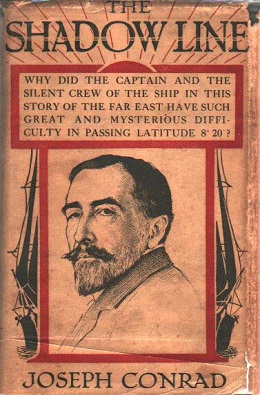
4. From The Shadow-line by Joseph Conrad

"To
Borys and all others
who like himself have crossed
in early youth the shadow-line
of their generation
With Love"

I had heard about people having to cross their shadow-line and used the expression myself in various ways it suggested itself to me for years before I actually read the book and found out precisely what Conrad meant by the term. The Shadow-line, he explains in the opening, is the moment of passage between youth and maturity, the moment when youth must be left behind.

“What moments?” he asks. “Why, the moments of boredom, of weariness, of dissatisfaction. Rash moments. I mean moments when the still young are inclined to commit rash actions.”

He also points out -- I love this -- that he doesn’t mean the very young, because the very young, "strictly speaking, have no moments at all".

As for the dedication, in September 1915 as Conrad was completing the manuscript of The Shadow-Line, his son Borys enlisted in the British Army, heading for the killing fields of France -- the Somme, in his case. He made it home alive and fifty years later he wrote a memoir (My father, Joseph Conrad) in which he looks affectionately at his famous father but where he also notes that his father, with his old-fashioned manners, had a difficult time expressing his love. In person.


5. From Amphigorey Again by Edward Gorey
 
"In fond collaborative memory…
Addeé Gorrwy
Aedwyrd Goré
Agowy Erderd
D. Awdrey-Gore
Deary Rewdgo
Dedge Yarrow
Dewda Yorger
Dogear Wryde
Dora Greydew
Dreary Wodge
Drew Dogyear
E.G. Deadworry
Edgar E. Wordy
Eduard Blutig
Edward Pig
Garrod Weedy
Gary Dredwoe
Grey Redwoad
Groeda Weyrd
O. Müde
Ogdred Weary
Om
Orde Graykdw
Raddory Gewe
Regera Dowdy
Roger Addyew
Roy Grewdead
Wardore Edgy
Waredo Dyrge
Wee Graddory
Ydora Wredge"


The Table of Contents of Amphigorey Again testifies to the originality and fruitfulness of these many collaborators (I started out thinking I would just copy a few, to give you the idea, but when it came time to leave some off, I just couldn't):

The galoshes of remorse -- Signs of spring -- Seasonal confusion -- Random walk -- Category -- The other statue -- 10 impossible objects (abridged) -- The universal solvent (abridged) -- Scenes de Ballet -- Verse advice -- The deadly blotter -- Creativity -- The retrieved locket -- The water flowers -- The haunted tea-cosy -- Christmas wrap-up -- The headless bust -- The just dessert -- The admonitory hippopotamus -- Neglected murderesses -- Tragedies topiares -- The raging tide -- The unknown vegetable -- Another random walk -- Serious life : a cruise -- Figbash acrobate -- La Malle Saignante -- The izzard book.

Yes, long before there was Lemony Snickett, long before there was Tim Burton, there was Edward Gorey, whose first book came out in 1953. And before Edward Gorey, there were Edward Lear and Lewis Carroll. There are a few clips of Edward Gorey floating around on youtube, mostly from interviews made in preparation for a documentary which as far as I can see never got made, which does seem to fit with the Edward Gorey spirit. Here's one where he talks about the nonsense line of the English literature family tree. You're in for a surprise, unless you expect Gorey to have a strong American accent, and to be wearing a yellow slicker rather than a velvet, perhaps threadworn, suit:


And at www.goreyography.com you can read such gems as "Growing up Gorey": Maurice Sendak, Alison Lurie and Andreas Brown all agree, Gorey is a Good Thing for the Kids.


August 25, 2012

What's Balzac famous for again?

Well, for me at least, coffee and 19th century French potboilers. Coffee that he prepared Turkish fashion, but infusing the grounds in cold water first to make it even stronger, and, why not, diminishing the amount of water until the coffee was a thick as soup, to then drink it on an empty stomach.

"And then the mind is aroused, ideas pour out like the regiments of the Grand Armée over the battlefield, and the battle begins. Memories come charging in with flags flying; the light cavalry of comparisons extends itself in a magnificent gallop; the artillery of logic hurries along with its ammunition train, and flashes of wit bob up like sharpshooters..." he wrote in his Treatise on Modern Stimulants.

Meanwhile, as his biographer André Maurois put it, "The paper gets covered with ink like the battlefield with black powder, the books get written and the author's heart suffers." This for sixteen hours at a stretch. Balzac seems to have drunk himself to his death on his coffee, dying at only 51, but into those 51 years he packed many lifetimes. Maurois again: "Balzac was by turns a saint, a criminal, an honest judge, a corrupt judge, a minister, a fop, a harlot, a duchess, and always a genius."

Or as another author fascinated by Balzac, V.S. Pritchett, put it in his biography, Balzac was "appetite itself" in an era (post-revolutionary France) in which "appetite was the note of the day".

My appetite for Balzac has been whetted by the work of getting ready for our upcoming Balzac celebration ("Balzac, baguettes and brie" at Central City Library, Wed. Aug. 29, 6:00 pm) and by the enthusiasm of Nicholas Reid, the historian, critic, and passionate Balzac reader and scholar who will be leading the show, assisted by Iain Sharp and, slightly, myself. I found the Maurois and Pritchett biographies in the fantastic Central City Library basement and have them here on my desk.

The Pritchett is densely illustrated with photos of Balzac's manuscripts, writing sets, dolls (read the book) and coffee pot, also engravings of Parisian soirées and reproductions of Balzac caricatures and portraits, even a statue, but not Rodin's famous bronze which I just last month saw at the Museum of Modern Art in New York, where, oddly, it stands in what is basically the approach to the stairwell. People stream by chatting or consulting their maps, paying it no attention. Except me, of course, I was circling it like an alert coyote, trying to capture all its dramatic mass with my iPad's camera and failing, as you can see.

I'm never sure if people read 19th century French authors anymore, Iain Sharp mused to me the other day. Well, when Vintage Classics asked all the Orange Prize winners what book they would pick to pass on to future generations, Rose Tremain picked Balzac's Eugenie Grandet, saying 'This brilliant but devastatingly sad novel moved me so much, I began it again the moment I got to the end'. And when George Plimpton asked John le Carré who his favourite authors were, Balzac topped the list. (A great interview, one of the Paris Review's great "The Art of Fiction" series of author interviews, which you can read in the Review's online archives.)

Nicholas Reid has a case to make for Balzac being the most unknown of the great French novelists, but actually the greatest of them all, the French equivalent of Dickens, and no man could receive higher praise from Nicholas. So if you've already read The Three Musketeers and The Hunchback of Notre Dame, maybe it's time to give Balzac a try. I've picked The Magic Skin, Balzac's precursor to The Portrait of Dorian Gray, as the first Balzac novel I'm going to read. Oh, and I've decided to take Pritchett's Balzac, too. I need to find out if the lady whom Balzac so desired to come "perch" on the fifty-foot divan which was the centrepiece of this huge, extravagant, man's apartment ever did.

Check out Reid's Reader, Nicholas Reid's blog of book reviews and comment.

Thanks to Beattie's Book Blog, the homepage of the New Zealand Book Community, where I encountered both the Rose Tremain and John le Carré testimonies.


July 27, 2012

Bob Orr, National Poet

Bob Orr will be reading at Poetry Central, the grand celebration of National Poetry Day taking place on July 27th, 5:30 pm, at Central City Library, featuring eleven fabulous readers and a celebration of nzepc's eleventh birthday.

This is one of my favourite Bob Orr poems, from his book Calypso, which we launched a few years back at another Poetry Central:

Samoa
 
I never did get to visit the grave
of Robert Louis Stevenson.
I wandered aimless about Apia's ramshackle markets
tasted a watermelon sliced open with a warm machete
drank the nectar of a green coconut beneath a pineapple sun
drank Vailima beer with a priest in a park
bought a fish from a boy on the side of the road
drank more beer at Aggie Grey's with the sad ghost of Marlon Brando.
But as for Robert Louis Stevenson
who could tell a palagi tourist about a man who lived on a mountain?
A very puzzled bus driver told me anyway he could be sleeping.
At Papa's fale the kids played outside on family graves
Papa sang away to himself on the porch
across the road a church was asleep until White Sunday
a pig nosed half-heartedly through broken coconut husks
a lizard slipped in and out of a crack in the ceiling's memory.
It kept a count I'm sure of every breath that I was taking
but could not recall for me the man of treasure island.
In the suddenness of the evening
the Pacific Ocean's cool machete split the sun in two
and at the same time just as sharply
divided what I know from what
I thought I knew.

July 16, 2012

Janet Charman, National Poet

Janet Charman, winner of the 2008 Montana New Zealand Book Awards poetry category, will be presenting her new book At the White Coast at Poetry Central, our celebration of National Poetry Day, which will be happening on July 27th at Central City Library, at 5:30 pm.

Here's one of her poems which I found in that wonderful book Contemporary New Zealand poets in performance, where you can also hear her read it on the accompanying CD.


going to work
 
darkness dispersing
the sky fills
with light
rain falls
the heavy weight of a hollow boat
leaves my heart

(2007)


July 10, 2012

John Newton, National Poet

John Newton is another of the poets who will be reading at Poetry Central, our annual celebration of National Poetry Day. The appointment is for July 27, at 5:30 pm, at Central City Library.

Here's one of John's poems from his book Lives of the poets:

Townes van Zandt at the Mangy Moose
 
'Hey Townes, play us something cheerful!" Oh man,
how did it come to this (a restaurant in Jackson Hole, Wyoming,
each night the same bunch of snow-dazzled ski bums
and tourists)? Not that the hecklers mean any harm: he works it
into a small routine ('Hey, these are the cheerful songs --
you don't want to hear the rest of them!'). Fiction, of course.
There are no others. Each song's a miracle that makes him
feel primed like a piston. But once, just once,
he'd like to explain to them (C'mon, stick to the goofy jokes),
tell them the story of Skinny Dennis, dying on Sunset
Beach with his boots on. Or try out his version of Galveston
O Galveston (Damn, he always loved that song!),
how he doesn't remember the sea waves crashing,
only the chlorpromazine and the forked lightning.

July 03, 2012

Murray Edmond, National Poet

Getting the word out about Poetry Central, our upcoming National Poetry Day celebration, taking place at Central City Library on July 27th, at 5:30 pm. Here's a wonderful poem by Murray Edmond, one of the eleven poets who will be reading from their work:.

Rhapsody in pink
 
all we had was cars
we hopped from foot to foot
rustic rock'n'roll
fever at a puritan wake
fumbling for a kiss
lacking both a capital
or a French letter
nevertheless our imaginary
start
drove us round the lake
drove round and round the lake
and we painted all our nails
kind of low-brow posh
we heaped coals on our lips
and saw the mystic sun
ends of the earth
that place was called

-- from Walls to kick and hills to sing from, a comedy with interruptions by Murray Edmond (2010)

June 19, 2012

Dear Heart: 150 New Zealand Love Poems

"I invite you to trespass on the look of love; to move and to sway, to be moved and to be swayed." -- Paula Green. introduction to Dear Heart.

Dear Heart is the title of the entrancing and surprising anthology of New Zealand love poems which Paula Green (co-editor with Harry Ricketts of that other fine book, 99 Ways into New Zealand Poetry) has put together with her usual keenness and care.

I say "entrancing and surprising" because I wasn't expecting -- and was entranced by the idea -- that the love poems would have as their objects, besides the classic beloved, a child, an Auntie, a bicycle.

Paula will be presenting her book in the Whare Wānanga at Central Library tomorrow evening. Twelve special-guest poets will be along to celebrate love poetry and Paula's book by reading their work to us. They are Angela Andrews, Janet Charman, Murray Edmond, Riemke Ensing, Kevin Ireland, Stephanie Johnson, Michele Leggott, Renee Liang, Selina Tusitala Marsh, Kiri Piahana-Wong, John Pule and NZ Poet Laureate Ian Wedde.

As happens with love objects, the form of the book is as bewitching as the contents, with illustrations by New Zealand artists Dick Frizzell, Michael Hight, Gregory O'Brien, John Pule and John Reynolds.


The Bicycle
by James Brown

I have always been lucky.
When I was seven
my parents gave me
a red bicycle.

I rode it every day until
it became a part of me.

It had a basket on the front,
and my father attached a bell
to make doing the deliveries
more noticeable.

Pedalling up hills
pushed me so far inside my head
that only reaching the top
could bring me back out.

Going down, my mouth would open
as the world became flocks
of many-coloured birds
soaring into flight.

I loved that bicycle.

Lying in bed listening
to rain sheet against the window
and knowing that tomorrow
it was Monday,

I would get up and go
into the hall and stare at it,
consoled by the standing
of its beautiful silence.


Powered by Blogger.