Showing posts with label #TBT. Show all posts

February 26, 2015

Throwback Thursday (Dies Iovis Reiectata): Latin charm

syndetics-lc"Why read the classics?" asks Italo Calvino in a famous essay published in The New York Review of Books. Then, true to form, instead of answering the question he just posed, the author noted for mixing irony, fable and allegory in works such as Cosmicomics and Invisible Cities, devotes the rest of his allocated space to "suggested definitions" of what makes a classic. Except that in a sort of game of mirrors, when he gets to the end and throws up his hands, we realise that he had been answering the question all along.

Here is how his list starts off:

The classics are the books of which we usually hear people say: “I am rereading…” and never “I am reading….”

Just as you are wondering if this implies you don't make the grade if you don't read your classics multiple times, Calvino deftly unhorses any such presumption. That reiterative prefix, he says, is almost always a small hypocrisy: people are ashamed to admit they've never read the title in question, so pass it off as a rereading.

But actually, he goes on to say, they shouldn't worry, because "read" or "reread" is of little importance with classics. Because,


Every reading of a classic is in fact a rereading.

And similarly, rereadings are like first readings, because, 

Every rereading of a classic is as much a voyage of discovery as the first reading.

I was reminded of these points recently thanks to the wonderful Central City Library basement with its seemingly endless store of old treasures, where I found these:


cover of Winnie Ille Pu
Winnie Ille Pu
Aliciae per speculum transitus

Winnie the Pooh and Through the Looking Glass in Latin!

May I put it out there right away that I have never studied Latin, except for a summer vacation twenty years ago with a book optimistically titled Latin made simple (ha!), and one or two encounters with bilingual editions of Latin poetry. But I have had so much fun leafing through these books. You don't need Latin - you just need to have loved the original. And enjoy words.

From Winnie Ille Pu, the scene where Pooh (sorry, Pu) tries to steal the bees' honey by floating up to their hive attached to a balloon ("folliculo" in Latin!):

'De apibus semper dubitandum est.' says Pu. Always be doubtful of bees.

Famous phrases by great Roman orators and writers are played on wherever possible:

"I don't hold with all this washing", grumbled Eeyore. "This modern Behind-the-ears nonsense."

And what does Ior say? He says "O tempora, o mos ablutionis retroauricularis!" "Oh, this modern custom of washing behind the ears", an adaptation of Cicero's famous exclamation on the shortcomings of his contemporaries, "O tempora, O mores". "Oh what times, oh what customs."

Such gems are pointed out, if you miss them, in notes in the back, which also provide many evocative instances of further information. For instance, we are told that when Pooh asks Christopher Robin if he can see which is the Queen Bee, this has been translated literally as regina apium, but the ancient Romans did not in fact use this expression. For them it was a rex apium, "the sovereign being regarded as a male".

Quite a few works of literature have been translated into Latin, from traditional 19th century classics such as Superbia et Odium (which you can read on line at ephemeris.alcuinus.net) to more modern childhood favourites such as Ursus Nomine Paddington, recently made into a imaginem subitariam.

See if you can guess what these translations correspond to:

Fundus Animalium

Puteus et Pendulum 

Vestes Novae Imperatoris

Tela Charlottae 

Quomodo invidiosulus nomine Grinchus Christi Natalem abrogaverit 

Fabula De Petro Cuniculo  

Insvla Thesavraria

Did you get them all? Congratulatio!


-- Karen

February 19, 2015

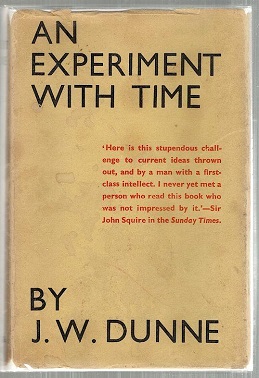
Throwback Thursday: An Experiment With Time

Guest post by Tim.

Dreamt Monday 9 Feb: On holiday with family and cats. Staying in beachside house. Sea levels rise overnight due to some kind of lunar/tidal anomaly. Woke to find house surrounded by water. Outside orca frolic and chase stingrays. Seems very menacing to me but children delighted and determined to jump in water to join in fun. I frantically run around stopping one from leaping out window into sea, only for another to escape and find new way to jump into water. Pedro (cat) somehow leaps into water too and also in danger of being eaten by orca. 

File:An Experiment with Time book cover.jpgThe above is part of the raw data I gathered while following the experimental method outlined in the book An Experiment withTime by J. W. Dunne. It was a bestseller at the time of publication (1927) and ran into many editions, but had fallen into obscurity by the time I came across it eighty-something years later in the basement of the Central City Library. In this little book Dunne writes about time and human perception of it, and his theory that we sometimes catch glimpses of the future when we dream. His experiment basically asks the reader to record their dreams every night, and to study them and note any similarities between them and subsequent waking events. 

Dunne was a very practical man apparently -- an aircraft engineer in the very early days of the field -- and goes to great pains to let us know that he is not interested in anything that cannot be explained rationally. "This is not a book about 'occultism', and not a book about what is called 'psycho-analysis'" he writes as soon as we get started. And it is interesting that he chose those two terms, too, because the crux of his argument rests upon the relationship between dreams and precognition. Keep clear, followers of Freud and Madame Blavatsky.

He writes in a friendly, professorial way that makes his theories seem so reasonable. And then he throws in some time-jargon such as: "the serialism of the fields of presentation involves the existence of a serial observer. In this respect every time-travelling field is the field apparent to a similarly travelling and similarly dimensioned observer. Observation by any such observer is observation by all observers pertaining to the dimensionally larger fields." Get it?  Sort of. And then, with diagrams and algebraic terms he outlines some convincing-looking ideas of time and multi-dimensional space and perception, and proves that we can all see the future in our dreams. 

It all seems so convincing that when he describes his own personal experiences with prophetic dreams (like the time he dreamt of being on a volcanic island and being aware that it would erupt and kill 4000 people and the very next day he saw the newspaper headline “Volcano disaster in Martinique 4000 killed”). I'm with him. I mean, everyone has had dreams that seem spookily prescient right? Whether that is precognition or just some quirk of neurology I don't know; but have I always liked the idea that there are things in the natural world that we don’t perceive properly, and that one nice thing about humans is that we really want to come up with ideas to explain them i.e. ghosts, UFOs, precognitive dreams, string theory….

I read An Experiment with Time a while ago but was reminded of it when I saw an article in the Times Literary Supplement (issue dated October 31 2014). In it was published the dream experiment as performed and described by Nabokov in 1964. Like Dunne, Nabokov was a man of scientific interests -- he was a well-respected amateur lepidopterist -- and also a Freud-denier. Nabokov seems genuinely open to the experiment and does seem to find some precognitive scraps amongst his dreams.

Some patches of prose in his dream diary are direct presentiments of his novel  Ada from 1967 (Van Veen, the 'hero' of Ada, writes a treatise on time, 'The Texture of Time', and describes his precognitive dreams as "dim-doom visions: fatidic-sign nightmares, thalamic calamities, menacing riddles.  Not infrequently the menace is well concealed, and the innocent incident will turn out to possess, if jotted down and looked up later, the kind of precognitive flavour that Dunne has explained by the action of "reverse memory").

 An Experiment with Time was popular in its day. I imagine earnest undergraduates in 1927 comparing dream diaries and finding thrilling grains of the future amongst them; or drunken dinner parties becoming suddenly hushed when prophecies are uncannily revealed. Maybe the real reason for its popularity was that Dunne’s experiment gave people permission to talk openly about their dreams (one of the Seven Things You’re Not Supposed To Talk About ).

I wrote about one of my dreams because Dunne made it okay, and because a few days later something happened that seemed somehow familiar even as it happened…

Thursday 12 Feb: Early in morning both rabbits escaped and were running around neighbourhood gardens. Me and S----- running around like slapstick comedians trying to catch them. Pedro was having great time helping round them up. Some correlation? Coincidence? Maybe this relates to dream of 9th ?…Any possible significance in the fact that rabbit escape was morning after I saw meteorite light up night sky, before it crash-landed in the ocean?

-- Tim

December 04, 2014

I Had a Dog AND A CAT: Throwback Thursday

Ah, the wonders of the Dewey Decimal System!

I Had a Dog AND A CAT, by the Czech novelist and playwright Karel Čapek, written as Europe cowered under the shadow, if not yet the jackboot, of Nazi Germany, and containing, as well as humourous stories about his beloved pets, pointed asides on such topics as dog Eugenics and the need to prepare for the birth of a Super-dog; the current vogue for Dobermans and Alsatians; the lack of a Czech national dog (but if this race existed, Čapek opines, its exemplars would undoubtedly be fattish, small and lie behind the stove and bark a lot); this book, I was saying, shares a shelf in the Central City Library's basement with Richard Dawkins's The selfish gene, three memoirs by the good-humoured animal collector Gerald Durrell, and An illustrated guide to common soil animals by H. Pauline McColl, all classified as 591.5, "Behaviour".

For his anti-fascist stance which he shared with his friend Tomáš Masaryk, the Czechoslovak president, the Gestapo declared Karel Čapek "Public Enemy Number 2" in Czechoslovakia, as if to say "Just wait til we get our hands on you". They never did, however, because Čapek died on Christmas Day 1938, a few months after France and England signed the Munich agreement which handed Czechoslovakia to Nazi Germany, but before the actual invasion. Čapek was an Anglophile who visited England often and was friends with George Bernard Shaw and G.K. Chesterton, and he seemed to have lost the will to live after Munich. His friends urged him to leave the country, without success. They had no better success at urging him to eat more. When he died, one of them said that the cause of death was "a stab in the heart from Neville Chamberlain's umbrella".

When the Nazis marched in, they didn't actually know Čapek had died, and did indeed go looking for him, and for his brother Josef, a noted writer, poet and artist, who contributed drawings in his trademark playful, primitive style of dogs, cats, and an occasional human, or human legs, to I Had a Dog AND A CAT. Josef was arrested and sent to a concentration camp, and died in Bergen Belsen in 1945.

syndetics-lc

Before coming across I Had a Dog AND A CAT, I only knew Karel Čapek as the man who brought into the world one of the best purpose-made words ever, "Robot" (he always capitalised it), from the Czech word robota, heavy labour, in his famous anti-utopian comedy R.U.R.; I knew he was considered a sort of non-hardcore Science-Fictiony type, along the lines of Aldous Huxley and George Orwell. But then I found another book in the library, published in 1990 on the 100th anniversary of his birth, with a foreword by a big fan of his, Arthur Miller.

Called Toward the Radical Center: A Karel Čapek Reader, it includes such gems as an act from the play "Lives of the Insects", with Mr and Mrs Dung Beetle waxing ecstatic -- "Our little capital! Our golden treasure!"-- over their dung ball (the stage direction is something like "Enter an enormous ball of manure pushed by two dung beetles"); a piece on gardening called "Legs and the Gardener"; one on, well, clumsy people, called "In Praise of Clumsy People"; and the irresistible "In Praise of Idleness". True idleness: not rest, and not repose. Rest is related to work, either recovering from or preparing for, and idleness must bear no relation to work. And repose implies activity, and pleasure. Idleness calls for neither. In fact, "It calls for nothing at all".

"And when a person is through idling", Čapek concludes, "he arises and returns as if from another world. Everything is a little alien and distant, distasteful somehow, and strained; and it is so.. so strange, that... a person has to take a little rest after being idle; and then after resting, lounge around for a while; and then relax a little more, then devote himself to a certain amount of inactivity, and only afterwards is he able to recover his strength and begin to do something completely useless."

You can read all of  "In Praise of Idleness", indeed all of Intimate things, the book where it first appeared in 1936, in the Universal Library of the Internet Archive.


November 20, 2014

Throwback Thursday: Flaubert in Egypt

When Truman Capote's New York society friends cut him off upon reading the first part of his self-described "Proustian" novel about them, Answered Prayers, he said he couldn't understand why they felt so betrayed. "What did they expect? I'm a writer!" was his line. It's a great line, and it comes back to me now and again, most recently during the reading of a small book with a long title which caught my eye down in the fabled Central City Library basement.

Flaubert in Egypt
A Sensibility on Tour
A Narrative drawn from
Gustave Flaubert's
Travel Notes & Letters 
translated from the French 
& edited by 
Francis Steegmuller

Francis Steegmuller being a noted Flaubert scholar and translator of Madame Bovary, not to mention a friend of Graham Greene and author of a French version of The Owl and the Pussycat, a masterpiece called Le Hibou et la Poussiquette, all of these points featuring in a Books in the City post a few years ago.

The artwork on this jewel was as enticing as the title. The front cover was a plunge into colourful Orientalism, a detail from Delacroix's Women of Algiers, while the back was given over to a period black and white photograph of sunbaked houses, their peeling facades chaotically arrayed with wooden-latticed balconies, a few scruffy acacias in the foreground. Did Flaubert take this photo? I wondered.

To my surprise the jacket flap claimed that it was a photo not by Flaubert, but of Flaubert! Flaubert in garden of the Hotel du Nil, Cairo, photo by Maxime du Camp, it clearly said. But where was he?


The mystery was solved when I got the book home and began reading it. A few pages in, a list of illustrations revealed that Flaubert in the Hotel du Nil garden was also reproduced opposite page 40. And sure enough, there he was -- dressed as a Nubian, yet.


The caption reads: Flaubert in Cairo, 1850. 'I would never allow anyone to photograph me. Max did it once but I was in Nubian costume, standing, and seen from a considerable distance, in a garden.' The garden is that of the Hotel du Nil, the name of one of whose proprietors, Bouvaret, Flaubert did not forget.

Yes, because Madame Bovary was still in Flaubert's future. For now, he was 28 years old, with drawers full of unpublished manuscripts in his study at his mother's house, proclaiming in a letter to her how little that mattered:

"Haven't I everything that's most enviable in the world? Independence, the freedom of my fancy, my two hundred trimmed pens, and the art of using them. And then the Orient, especially Egypt, flattens out all the little worldly vanities... The sight of so many ruins destroys any desire to build shanties; all this ancient dust makes one indifferent to fame..."

One of my favourite moments is when his mother suggests that on his return he might get "une petite place", a small job. "Frankly, and without deluding yourself," he replies, "is there a single one that I am capable of filling?" And anyway, "Isn't not to be bored one of the principal goals of life?"

The letters are full of experiences which would keep one from being bored. Flaubert sees dervishes stuck through with iron spikes, he visits a Coptic church and thinks of what Voltaire would have said, he observes the ceremony of the Doseh ('Treading') where a sheik rides on horseback over a human plank of 200 prostrate men, he holds a charmed snake, he gallops off to take in the Sphinx, the sight of which nearly makes him giddy.

A high point of the adventure, perhaps the high point, is convincing the famed dancing girl Kuchuk Hanem to dance "the Bee", the most notorious of the oriental dances, banned by the authorities. The door has to be closed, everyone sent away except for the musicians, who are blindfolded. I expected that "the Bee" would be Kuchuk flitting around as if she were a bee, but no, it is Kuchuk pretending to be fighting off a very pesky bee, shedding her clothing piece by piece. "Finally she was naked except for a fichu which she held in her hands and behind which she pretended to hide, and at the very end she threw down the fichu. That was the Bee." And then to bed, together. "She insisted on keeping the outside."

In a note, Steegmuller tells us that Flaubert's mistress read his travel notes and in her jealousy, seized on a mention of Kuchuk's bedbugs, saying they degraded her. Pas de tout, replied Flaubert. The smell of Kuchuk's bedbugs were "the most enchanting touch of all. Their nauseating odor mingled with the scent of her skin, which was dripping with sandalwood oil. I want a touch of bitterness in everything -- always a jeer in the midst of our triumphs, desolation even in the midst of enthusiasm."

What did I say? A writer!

The most striking passage for me is contained in a letter to his dear friend Louis Bouilhet, sent from Cairo, at the end of his trip, June 1850. Perhaps it was a thought which came to him there among the scruffy acacias of the Hotel du Nil.

"Let's not get lost in archeology -- a widespread and fatal tendency, I think, of the coming generation... the world is going to become bloody stupid and from now on will be a very boring place. Max and I talk constantly about the future of society. For me it is almost certain that at some more or less distant time it will be regulated like a college. Teachers will be the law. Everyone will be in uniform. Humanity will no longer commit barbarisms as it writes its insipid theme, but --- what wretched style! What lack of form, of rhythm, of spirit!"

A year after his return to France, he began Madame Bovary, going off in a new direction from all that he had written before, taking literature ("the old whore" as he calls it in one of his letters) in a new direction as well. But as Steegmuller points out, romantic echoes of Egypt still sounded now and again. In The Temptation of Saint Anthony, the Queen of Sheba tempts the saint by telling him "I dance like a bee".


The books:
Flaubert in Egypt ed by Francis Steegmuller
Madame Bovary by Gustave Flaubert
The Temptation of Saint Anthony by Gustave Flaubert
and
Answered prayers by Truman Capote

 
Powered by Blogger.