Showing posts with label Tim. Show all posts

May 24, 2015

Dave Veart's New Zealand Toy Story at AWF15

     
   syndetics-lc
Tim Kidd tells us about the seriously fun session he attended, as our AWF15 coverage continues. 

LUVME…  FUNHO!...

Perfect names for toy companies. Names I remember from the tag on a cloth cat, whose stomach unzipped to accommodate a hot water bottle, and from the underside of the pocket-sized yellow bulldozers that I seem to have found in every sandpit I ever came across, as kid or adult.

JUMBO…  TIGER…  CRANKO…  MO-BO…  HERCULES…

In the heyday of New Zealand toy manufacturing, these companies and others made fun things for boys and girls to play with. Dave Veart’s book Hello Girls and Boys! A New Zealand Toy Story is a history of toys in New Zealand and it tells the story of these manufacturers and much more besides.

I went to Veart’s session, one of the Writers Festival's Weekend Gallery Series, and was impressed with what a smart and entertaining speaker he was. Of course toys are a fun subject, and there were so many great images to look at -- beautiful paper dolls, amazing Meccano sets, two boys driving their homemade go-kart down the road at rush hour!-- but Veart, with his archaeologist background, knew how to extract the full story every time. His book is one of those social histories told through the prism of a given subject, and it seems like the feeling of a particular time and place really is funneled, unfiltered, into the things that children play with-- and way ahead of what adults might be seeing.

Veart went back to the early days of New Zealand and the wonderful toys Maori children would play with – kites, knucklebones, spinning tops that raced over complicated tracks –did I hear him say they had tops that could climb trees? Not sure; I hope so.

In the 19th century, New Zealand children were apparently notorious for being particularly wild -- "lots of kids, lots of wild space, not much adult control". The neighbourhood I live in would have been like that a hundred or so years ago, but now I think it is the exact opposite. A great photo of these wild children shows them dressed up as pirates and soldiers and other things fun and jaunty, but then there’s one kid who is swathed in what looks like matted sheep wool. Is he some kind of castaway figure ? A wild man? I don’t know. It looks fun though. The toy of choice for these kids: the Pampas pocket knife (I’m pretty sure my Dad has one). Sharpen pencils, cut fruit and, crucially, make your own shanghai. Again, pretty sure none of the kids at our local primary school are knife-wielders.

Fifty years later and kids were more civilised and played with trains and Meccano and dolls houses. They became the town planners of the future. There was a picture of a modernist doll’s house that I really loved. Some hep dolls in the fifties got themselves a swinging pad one Christmas. I am pretty jealous of anyone who got one of those.

After the Second World War, import restrictions meant that the local toy industry flourished, but by the eighties that had all changed and toy companies folded one by one. I remember when I was in primary school in the early eighties, how suddenly there were these amazing futuristic toys – Zoids, Transformers, and all the other robo-hydrid toys. At the time, as a kid, it seemed like the greatest time for toys. But now I’m sad about those small, singular things that disappeared.

Like the story of Johnny Prowse who ran North Shore Toys. His factory was located opposite a primary school. A lot of employees were parents of students and worked school hours. I like that there is a particular group of adults who still remember what it felt like to finish school every day and walk across the road to the toy factory where Mum or Dad worked. Even better, there was a space at the factory for employees' preschool children - the kapok room!

As an adult, looking back, I think I’d surely trade my Optimus Prime, much as I loved it, for a memory of playing in that room.

-- Tim


Auckland Writers Festival

February 19, 2015

Throwback Thursday: An Experiment With Time

Guest post by Tim.

Dreamt Monday 9 Feb: On holiday with family and cats. Staying in beachside house. Sea levels rise overnight due to some kind of lunar/tidal anomaly. Woke to find house surrounded by water. Outside orca frolic and chase stingrays. Seems very menacing to me but children delighted and determined to jump in water to join in fun. I frantically run around stopping one from leaping out window into sea, only for another to escape and find new way to jump into water. Pedro (cat) somehow leaps into water too and also in danger of being eaten by orca. 

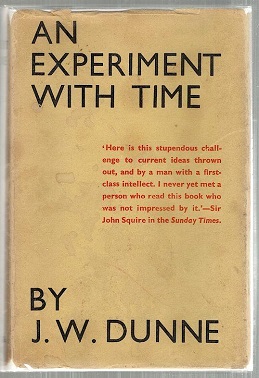
File:An Experiment with Time book cover.jpgThe above is part of the raw data I gathered while following the experimental method outlined in the book An Experiment withTime by J. W. Dunne. It was a bestseller at the time of publication (1927) and ran into many editions, but had fallen into obscurity by the time I came across it eighty-something years later in the basement of the Central City Library. In this little book Dunne writes about time and human perception of it, and his theory that we sometimes catch glimpses of the future when we dream. His experiment basically asks the reader to record their dreams every night, and to study them and note any similarities between them and subsequent waking events. 

Dunne was a very practical man apparently -- an aircraft engineer in the very early days of the field -- and goes to great pains to let us know that he is not interested in anything that cannot be explained rationally. "This is not a book about 'occultism', and not a book about what is called 'psycho-analysis'" he writes as soon as we get started. And it is interesting that he chose those two terms, too, because the crux of his argument rests upon the relationship between dreams and precognition. Keep clear, followers of Freud and Madame Blavatsky.

He writes in a friendly, professorial way that makes his theories seem so reasonable. And then he throws in some time-jargon such as: "the serialism of the fields of presentation involves the existence of a serial observer. In this respect every time-travelling field is the field apparent to a similarly travelling and similarly dimensioned observer. Observation by any such observer is observation by all observers pertaining to the dimensionally larger fields." Get it?  Sort of. And then, with diagrams and algebraic terms he outlines some convincing-looking ideas of time and multi-dimensional space and perception, and proves that we can all see the future in our dreams. 

It all seems so convincing that when he describes his own personal experiences with prophetic dreams (like the time he dreamt of being on a volcanic island and being aware that it would erupt and kill 4000 people and the very next day he saw the newspaper headline “Volcano disaster in Martinique 4000 killed”). I'm with him. I mean, everyone has had dreams that seem spookily prescient right? Whether that is precognition or just some quirk of neurology I don't know; but have I always liked the idea that there are things in the natural world that we don’t perceive properly, and that one nice thing about humans is that we really want to come up with ideas to explain them i.e. ghosts, UFOs, precognitive dreams, string theory….

I read An Experiment with Time a while ago but was reminded of it when I saw an article in the Times Literary Supplement (issue dated October 31 2014). In it was published the dream experiment as performed and described by Nabokov in 1964. Like Dunne, Nabokov was a man of scientific interests -- he was a well-respected amateur lepidopterist -- and also a Freud-denier. Nabokov seems genuinely open to the experiment and does seem to find some precognitive scraps amongst his dreams.

Some patches of prose in his dream diary are direct presentiments of his novel  Ada from 1967 (Van Veen, the 'hero' of Ada, writes a treatise on time, 'The Texture of Time', and describes his precognitive dreams as "dim-doom visions: fatidic-sign nightmares, thalamic calamities, menacing riddles.  Not infrequently the menace is well concealed, and the innocent incident will turn out to possess, if jotted down and looked up later, the kind of precognitive flavour that Dunne has explained by the action of "reverse memory").

 An Experiment with Time was popular in its day. I imagine earnest undergraduates in 1927 comparing dream diaries and finding thrilling grains of the future amongst them; or drunken dinner parties becoming suddenly hushed when prophecies are uncannily revealed. Maybe the real reason for its popularity was that Dunne’s experiment gave people permission to talk openly about their dreams (one of the Seven Things You’re Not Supposed To Talk About ).

I wrote about one of my dreams because Dunne made it okay, and because a few days later something happened that seemed somehow familiar even as it happened…

Thursday 12 Feb: Early in morning both rabbits escaped and were running around neighbourhood gardens. Me and S----- running around like slapstick comedians trying to catch them. Pedro was having great time helping round them up. Some correlation? Coincidence? Maybe this relates to dream of 9th ?…Any possible significance in the fact that rabbit escape was morning after I saw meteorite light up night sky, before it crash-landed in the ocean?

-- Tim

May 20, 2014

Auckland Writers Festival 2014: "Trouble in Mind" with Jenni Ogden

Guest post by Tim, Readers Services, Central City Library.


The crowd waiting to hear Jenni Ogden speak was large and noisy. I could hardly hear the Black Sabbath song I was trying to listen to. There were people outside the room talking loudly. A man sat down to my left and I wondered if I knew him vaguely. Everyone seemed distracted. Then we all turned to look because the distinguished academic with a soothing voice came on stage to introduce Jenni Ogden -- renowned neuropsychologist and author of Trouble in Minda selection of case histories of people with damage to their brains of one kind or another.

When Ogden came on, her energy and wit and enviable ease with talking (I have two left hemispheres, she quipped) caught the crowd’s attention and held it throughout. She asked us to raise our hands if we knew someone affected by brain trauma. Most of us did. She spoke of her time at MIT studying the most famous brain in the world -- the brain that belonged to the man known as HM in text books, Henry Molaison. His hippocampus had been removed in 1957 in an experimental procedure intended to cure him of epilepsy, a procedure that also robbed him of the ability to create new memories.

Ogden described how HM was awake during the procedure, but because he had been sedated was probably too drowsy to notice this ability disappear -- but would you even notice this? When she knew him it was years later, but time had not really passed for HM, if the measurement of time is the laying down of memories, as Ogden argued. HM had a note in his pocket that he would happen upon every now and then which read "Dad is dead Mom is well". Every time it was (sad) news to him.


Ogden also described a woman who had a hole in her brain, and another woman who, because of a brain tumour, came to disregard anything to her left -- including her own left arm. The man to my left uttered in surprise “She was a friend of mine.”

I left feeling a little more fragile of mind maybe, but excited to read Trouble in Mind. And I wondered, too, if Jenni Ogden knows some arcane neuropsychological secret the rest of us don’t know -- the kind that keeps someone irreverent and energetic in perpetuity. Maybe it’s in the book.

May 17, 2011

Graphic Novels, Comics & Cartoons at AWRF 2011

Tim Kidd from Readers Services is a comics reader, creator and appreciator, and the person who takes care of the teeming comics and graphic novel shelves at Central City Library. He is also the only person on our library quiz team who knew which creature possesses the largest eye in the animal kingdom. It's the giant squid. Here Tim casts his own eye (in black bakelike glasses) on the comics and graphic novels session at the Auckland Writers and Readers Festival, which was chaired by Adrian Kinnaird, cartoonist and writer of the New Zealand Comics blog From Earth's End.
 
The guests were Karen Healey, Dylan Horrocks, Chris Slane and Ant Sang. All four have had books published in the last year, which are available in regular bookstores around the country. Dylan re-released his major work, Hicksville, last year, with a new design, new cover and a lovely new comics-form introduction; Guardian of the Dead is Karen Healey’s latest, award-winning teen novel; Ant Sang’s Shaolin Burning is set in medieval China and tells the story of Plum Blossom, a young woman who is determined to be the best Kung Fu warrior in the land; and Chris Slane’s Nice Day for a War adapts the diaries of Cyril Elliott, a soldier who served in the trenches in France. A big year for New Zealand comics.

It was a nice hour, led by Adrian Kinnaird, who began by asking the creators to talk about their early experiences reading comics, accompanied by pictures of Spiderman, Casper, Tintin, Donald Duck etc. projected on the big screens.

Then Karen and Dylan discussed the role of women in superhero comics. Karen Healey had been involved in the Girl Wonder group that was concerned with rehabilitating the male-centric genre of superheroes for everyone. Dylan had written Batgirl for some time and so had some insights to bring to a conversation about the poor treatment of women superheroes in recent years (for an interview with her and Mr Kinnaird about this and more go to http://fromearthsend.blogspot.com/)

But my favourite part of the talk was when the cartoonists showed some of the preparatory material that went into their finished comics. It was illuminating to see these private sketches and notes blown up large on the big screen. They are such good cartoonists that even what they might consider a throwaway working-drawing still looked great enlarged a hundred times the size. I could see that what might take just a few seconds to read on the page could take many days of work to make. And I liked seeing the very different approaches they took to construct their stories.

Slane was obliged to do historical research for his book and he certainly did not take any shortcuts. Images of the battle fields in France as they look today on Google Earth, tourist photos of the area uploaded to the internet (beautiful green rolling pastures, lovely vineyards, cyclists) were married to photos taken by soldiers of the time ( blackened limbless trees, shattered buildings, mud, holes) and maps of battle positions and trench layouts. These gave him the ability to place his characters into the landscape. He went on to show how he unobtrusively incorporated all this reference work into the finished pages.

It was nice to see his thumbnails (small, sketchy drawings made to plan the comic page as a whole and test how one panel flows to the next). He showed how these were tightened up into more detailed sketches to get the character placement right, the story information clearly shown, and to check for readability. I thought these sketches from him looked good enough to publish as they were. But there was a further version of the page to work out the balance of dark and light tones. Only then came the finished drawings- done in pencil and watercolour. The writing, for him, he said, was inseparable from the drawing.

Ant Sang's Shaolin Burning is a beautifully crafted story and I was excited to see that Ant had chosen to show us the plotting process. He used techniques adapted from cinematic writing and his book does have the feel of a great dramatic action movie. To see the way he diagrammed the plot and the characters' transitions and development was fascinating. He displayed pages full of tiny notes with scribbled arrows leading to other notes to other arrows to more notes. A pair of columns of writing side by side -- each one representing a character -- with arrows shooting back and forth; triangles with words at each corner. His writing was arranged in a very visual way.

Dylan showed the pages from the script notebook he uses for his new story The Magic Pen, as serialised on his website hicksvillecomics.com. To see someone's handwriting blown up so large was very personal and nice. A cartoonist needs to be clear above all other things and he excels at this. I thought it was neat that even his hand-written notes are a model of clarity. Then he showed how a few sketches in the corner of a page could expand into a new character and then how that character could intrude into the story so much that the whole thing changed. It all seemed natural and fun.

-- Tim Kidd

 
Powered by Blogger.