February 26, 2015

Throwback Thursday (Dies Iovis Reiectata): Latin charm

syndetics-lc"Why read the classics?" asks Italo Calvino in a famous essay published in The New York Review of Books. Then, true to form, instead of answering the question he just posed, the author noted for mixing irony, fable and allegory in works such as Cosmicomics and Invisible Cities, devotes the rest of his allocated space to "suggested definitions" of what makes a classic. Except that in a sort of game of mirrors, when he gets to the end and throws up his hands, we realise that he had been answering the question all along.

Here is how his list starts off:

The classics are the books of which we usually hear people say: “I am rereading…” and never “I am reading….”

Just as you are wondering if this implies you don't make the grade if you don't read your classics multiple times, Calvino deftly unhorses any such presumption. That reiterative prefix, he says, is almost always a small hypocrisy: people are ashamed to admit they've never read the title in question, so pass it off as a rereading.

But actually, he goes on to say, they shouldn't worry, because "read" or "reread" is of little importance with classics. Because,


Every reading of a classic is in fact a rereading.

And similarly, rereadings are like first readings, because, 

Every rereading of a classic is as much a voyage of discovery as the first reading.

I was reminded of these points recently thanks to the wonderful Central City Library basement with its seemingly endless store of old treasures, where I found these:


cover of Winnie Ille Pu
Winnie Ille Pu
Aliciae per speculum transitus

Winnie the Pooh and Through the Looking Glass in Latin!

May I put it out there right away that I have never studied Latin, except for a summer vacation twenty years ago with a book optimistically titled Latin made simple (ha!), and one or two encounters with bilingual editions of Latin poetry. But I have had so much fun leafing through these books. You don't need Latin - you just need to have loved the original. And enjoy words.

From Winnie Ille Pu, the scene where Pooh (sorry, Pu) tries to steal the bees' honey by floating up to their hive attached to a balloon ("folliculo" in Latin!):

'De apibus semper dubitandum est.' says Pu. Always be doubtful of bees.

Famous phrases by great Roman orators and writers are played on wherever possible:

"I don't hold with all this washing", grumbled Eeyore. "This modern Behind-the-ears nonsense."

And what does Ior say? He says "O tempora, o mos ablutionis retroauricularis!" "Oh, this modern custom of washing behind the ears", an adaptation of Cicero's famous exclamation on the shortcomings of his contemporaries, "O tempora, O mores". "Oh what times, oh what customs."

Such gems are pointed out, if you miss them, in notes in the back, which also provide many evocative instances of further information. For instance, we are told that when Pooh asks Christopher Robin if he can see which is the Queen Bee, this has been translated literally as regina apium, but the ancient Romans did not in fact use this expression. For them it was a rex apium, "the sovereign being regarded as a male".

Quite a few works of literature have been translated into Latin, from traditional 19th century classics such as Superbia et Odium (which you can read on line at ephemeris.alcuinus.net) to more modern childhood favourites such as Ursus Nomine Paddington, recently made into a imaginem subitariam.

See if you can guess what these translations correspond to:

Fundus Animalium

Puteus et Pendulum 

Vestes Novae Imperatoris

Tela Charlottae 

Quomodo invidiosulus nomine Grinchus Christi Natalem abrogaverit 

Fabula De Petro Cuniculo  

Insvla Thesavraria

Did you get them all? Congratulatio!


-- Karen

February 24, 2015

Planes, trains and literary loves

syndetics-lcI still laugh about the wintry morning when I headed into the library so distracted by thoughts about trains, or rather, about stories with trains  -- Anna Karenina throwing herself under a train, Coral Musker aboard the Orient Express with the guard calling "Budapest!" as a fellow passenger presses a folded note into her hand -- that I walked right into a big green loden coat. To my delight, the person inside the big coat was Paul Reynolds, the visionary who developed our first website, but also, and in this case more importantly, a keen reader, who in fact had earned his living as a book reviewer when he first arrived from the UK.

Just the person to consult about the question which had me racking my brain: I could think of many books in which trains feature as elements of mystery, excitement, danger -- of romance, in short; but were there not any where airplanes play a similar role? Paul was on to it in a flash. "What about Biggles?", he said.

The story came to mind because I've been reading The Pleasure of Reading, a collection of pieces by noted writers about their literary loves, in which John Carey, Merton Professor of English at Oxford University, also for many years the book reviewer for the Sunday Times, a literature lover who won my heart at an AWRF a few years back, when in a debate inspired by his book What good are the arts? he opined that it's not actually clear that reading books makes anyone a better person, and  more generally for his erudition and wit, has his own Biggles story to tell. Here it is:

Prof. John Carey. Photograph: David Levenson/Getty Images

"Contemporary writing was not represented on the shelves [of the house he grew up in], so for that I had to depend on birthday and Christmas presents, and loans from friends. My favourite modern author was Captain W.E. Johns. I must have read nearly all his Biggles books (though not the cissy Worrals-of-the-WAAF series, of course). The Biggles adventures that most gripped me were the exotic ones. Biggles in the Orient was a marvel of deft plotting about a series of inexplicable crashes among the fighter planes operating against the Japs from a certain Burmese airfield. Inspecting the wreckage of one plane, Biggles finds a scrap of peppermint-scented silver paper. Chewing gum! All at once it dawns on him. Someone must be drugging the pilots' confectionery, so that they pass out when flying over the jungle. Sure enough, back at base, a 'moonfaced' Eurasian mess steward is found injecting the squadron's chewing-gum with a hypodermic. Curtains for Moon-Face.

The scrap of pepperminty paper strikes me, even now, as a brilliant touch -- like the chocolate-paper William Golding's shipwrecked Pincher Martin finds in his pocket, with one agonizingly sweet crumb of chocolate still adhering to it. Perhaps Golding was a Biggles fan, too.

syndetics-lcBiggles in the South Seas enthralled me even more. I forget the plot, but in one episode Biggles's friend Ginger becomes romantically attached to a young female South Sea Islander, and they have an adventure with a giant octopus, involving a lung-searing underwater swim. The girl is clad -- scantily, one gathers -- in something called a pareu. I had no idea what this garment was, but it lingered pleasantly in my mind, eventually getting mixed up with the brief costume worn by Jean Simmons in The Blue Lagoon. Like many teenagers, I felt sure, as puberty approached, that my destiny was to be a poet, and Ginger's girl's pareu figured importantly among my early inspirations, combined with the world-weary tones of T.S. Eliot's J. Alfred Prufrock, whose 'Love Song' completely captivated me after a single reading. I wrote some wistful, elderly recollections of my youth in the South Seas, in free verse, and tapped out my poems one-fingered on my father's huge old Underwood, which lurked under a sort of tarpaulin shroud in the front room. This took a long time, as I had no way of correcting typing errors, and as soon as I made one my authorial pride obliged me to start the whole page again. At last I produced perfect copies, however, and sent them off to The Listener for publication. Why I chose The Listener escapes me, but I realize now that the then literary editor was J.R. Ackerley, later famous for his love affair with his Alsatian bitch Queenie, which he wrote up in My Dog Tulip. However, my tasteful blend of Biggles and T.S. Eliot must have seemed unusual, even to someone of his wide experience.

My poems were some time in coming back, as I had omitted to enclose a stamped, addressed envelope. This was pointed out (in the great Ackerley's hand?) on the rejection slip, which was decorated with the BBC's crest in pastel blue. I was not as pained as I had expected. Being a rejected poet seemed somehow even finer than being published."

syndetics-lcsyndetics-lc


-- Karen

February 19, 2015

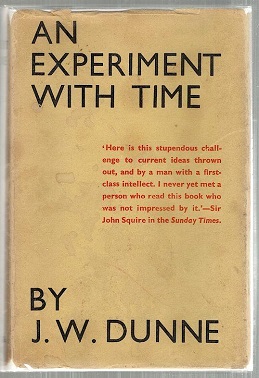
Throwback Thursday: An Experiment With Time

Guest post by Tim.

Dreamt Monday 9 Feb: On holiday with family and cats. Staying in beachside house. Sea levels rise overnight due to some kind of lunar/tidal anomaly. Woke to find house surrounded by water. Outside orca frolic and chase stingrays. Seems very menacing to me but children delighted and determined to jump in water to join in fun. I frantically run around stopping one from leaping out window into sea, only for another to escape and find new way to jump into water. Pedro (cat) somehow leaps into water too and also in danger of being eaten by orca. 

File:An Experiment with Time book cover.jpgThe above is part of the raw data I gathered while following the experimental method outlined in the book An Experiment withTime by J. W. Dunne. It was a bestseller at the time of publication (1927) and ran into many editions, but had fallen into obscurity by the time I came across it eighty-something years later in the basement of the Central City Library. In this little book Dunne writes about time and human perception of it, and his theory that we sometimes catch glimpses of the future when we dream. His experiment basically asks the reader to record their dreams every night, and to study them and note any similarities between them and subsequent waking events. 

Dunne was a very practical man apparently -- an aircraft engineer in the very early days of the field -- and goes to great pains to let us know that he is not interested in anything that cannot be explained rationally. "This is not a book about 'occultism', and not a book about what is called 'psycho-analysis'" he writes as soon as we get started. And it is interesting that he chose those two terms, too, because the crux of his argument rests upon the relationship between dreams and precognition. Keep clear, followers of Freud and Madame Blavatsky.

He writes in a friendly, professorial way that makes his theories seem so reasonable. And then he throws in some time-jargon such as: "the serialism of the fields of presentation involves the existence of a serial observer. In this respect every time-travelling field is the field apparent to a similarly travelling and similarly dimensioned observer. Observation by any such observer is observation by all observers pertaining to the dimensionally larger fields." Get it?  Sort of. And then, with diagrams and algebraic terms he outlines some convincing-looking ideas of time and multi-dimensional space and perception, and proves that we can all see the future in our dreams. 

It all seems so convincing that when he describes his own personal experiences with prophetic dreams (like the time he dreamt of being on a volcanic island and being aware that it would erupt and kill 4000 people and the very next day he saw the newspaper headline “Volcano disaster in Martinique 4000 killed”). I'm with him. I mean, everyone has had dreams that seem spookily prescient right? Whether that is precognition or just some quirk of neurology I don't know; but have I always liked the idea that there are things in the natural world that we don’t perceive properly, and that one nice thing about humans is that we really want to come up with ideas to explain them i.e. ghosts, UFOs, precognitive dreams, string theory….

I read An Experiment with Time a while ago but was reminded of it when I saw an article in the Times Literary Supplement (issue dated October 31 2014). In it was published the dream experiment as performed and described by Nabokov in 1964. Like Dunne, Nabokov was a man of scientific interests -- he was a well-respected amateur lepidopterist -- and also a Freud-denier. Nabokov seems genuinely open to the experiment and does seem to find some precognitive scraps amongst his dreams.

Some patches of prose in his dream diary are direct presentiments of his novel  Ada from 1967 (Van Veen, the 'hero' of Ada, writes a treatise on time, 'The Texture of Time', and describes his precognitive dreams as "dim-doom visions: fatidic-sign nightmares, thalamic calamities, menacing riddles.  Not infrequently the menace is well concealed, and the innocent incident will turn out to possess, if jotted down and looked up later, the kind of precognitive flavour that Dunne has explained by the action of "reverse memory").

 An Experiment with Time was popular in its day. I imagine earnest undergraduates in 1927 comparing dream diaries and finding thrilling grains of the future amongst them; or drunken dinner parties becoming suddenly hushed when prophecies are uncannily revealed. Maybe the real reason for its popularity was that Dunne’s experiment gave people permission to talk openly about their dreams (one of the Seven Things You’re Not Supposed To Talk About ).

I wrote about one of my dreams because Dunne made it okay, and because a few days later something happened that seemed somehow familiar even as it happened…

Thursday 12 Feb: Early in morning both rabbits escaped and were running around neighbourhood gardens. Me and S----- running around like slapstick comedians trying to catch them. Pedro was having great time helping round them up. Some correlation? Coincidence? Maybe this relates to dream of 9th ?…Any possible significance in the fact that rabbit escape was morning after I saw meteorite light up night sky, before it crash-landed in the ocean?

-- Tim

February 17, 2015

Remembering Philip Levine

               ...Somewhere
we'll leave the world weighing
no more than when we came

wrote Philip Levine in his poem "A late answer". After I learned that he had died this weekend, I got my book of his poems down from the shelf, and found I had left a marker at that page the last time I was reading in it -- a sheet torn from a local elections booklet, dated October 2013.

I can't place the circumstance, but I can of the other marker in the book, a folded blue post-it. Only my father would have had post-its on hand as he read poetry, and indeed, it was he who had used one to mark another poem, his favourite, the one with which he introduced me to Philip Levine, some twenty years ago now. "Have you read this?" he had said with palpable excitement, handing me the book. It was one of Levine's most famous poems, "They feed they lion".

I remember clearly that moment when I fell under the spell of Philip Levine, of his poem with its rumble of the assembly line, its incisive cadences, its fierce old-testament imagery, all driving it unrelentingly, hypnotically, to its conclusion. "They feed they lion", like James Baldwin's "The fire next time". The fire now. The poem is from the late sixties, the time of "Burn baby burn!", the terrible riots which erupted across America in the wake of Martin Luther King's assassination. The city of Detroit, where Levine had worked on a car factory's assembly line with a man who spoke the words which became the poem's title (noticing that the burlap sacks they had been given to fill with old car parts were stamped "Detroit Municipal Zoo"), was one of the worst hit.

Here's Philip Levine reading it:


...From my five arms and all my hands,
From all my white sins forgiven, they feed,
From my car passing under the stars,
They Lion, from my children inherit,
From the oak turned to a wall, they Lion,
From they sack and they belly opened
And all that was hidden burning on the oil-stained earth
They feed they Lion and he comes.

In the farewells flooding the media, I see Philip Levine being described as the poet who sang of blue-collar America. Having read his description of the effect the Spanish Civil War had on him as a boy in his wonderful memoir The bread of time: toward an autobiography , I can't help but feel that his wrath was aroused by injustice, greed, oppression of the spirit wherever, in whatever form. The workingman's plight was simply his own experience of it.

My own favourite Philip Levine poem differs from "They feed they lion" in being markedly personal, but it is just as intense. Written later in life, it's about his memories of his father -- the relevance of this does not escape me -- and the revelation (Levine's poems always have a revelation, or at least that's how I read them) is the indomitable capacity of the spirit, however world-weary, for renewal. It's called "Starlight", and amazingly enough, I had remembered the poem just this weekend, lying on a picnic table looking up at the night sky, watching for shooting stars. We were on "the Barrier", Great Barrier Island, far from city lights, from any lights, with the stars almost blindingly bright. Shooting stars didn't lack. I like to think that one of them was Philip Levine's spirit, passing over.

Here he is reading "Starlight", from the film "In person: 30 poets", and the text below so you can follow if you like.


Starlight

My father stands in the warm evening
on the porch of my first house.
I am four years old and growing tired.
I see his head among the stars,
the glow of his cigarette, redder
than the summer moon riding
low over the old neighborhood. We
are alone, and he asks me if I am happy.
“Are you happy?” I cannot answer.
I do not really understand the word,
and the voice, my father’s voice, is not
his voice, but somehow thick and choked,
a voice I have not heard before, but
heard often since. He bends and passes
a thumb beneath each of my eyes.
The cigarette is gone, but I can smell
the tiredness that hangs on his breath.
He has found nothing, and he smiles
and holds my head with both his hands.
Then he lifts me to his shoulder,
and now I too am among the stars,
as tall as he. Are you happy? I say.
He nods in answer, Yes! oh yes! oh yes!
And in that new voice he says nothing,
holding my head tight against his head,
his eyes closed up against the starlight,
as though those tiny blinking eyes
of light might find a tall, gaunt child
holding his child against the promises
of autumn, until the boy slept
never to waken in that world again.


Philip Levine, Selected poems

-- Karen

February 11, 2015

Robert Stone 1937-2015

Guest post by Kelly


(photo: New York Times)

There are books you hold gingerly, somehow aware that they exclude a charisma, demanding respect if not immediate understanding. That’s the feeling on first encountering Robert Stone's Dog soldiers, a book that has as much to offer now as when it was first published. 


(New York Times)

Robert Stone died last week. He was seventy-seven and in his time had written eight novels, two short story collections and a memoir. Not a huge count. Contemporaries such as Larry McMurtry, who attended the same university writing programme as Stone, have published well into the double digits. Hard living had something to do with that, but the fact is Stone's books are monoliths. Volumes carved out of hard truths, unflinching in their attempt to appreciate the harsh reality of his time and place. They must have demanded a great deal from him. 


(Buddenbrooks)

You can see some of the character which drove the creation of those books in online interviews. There is one from toward the end of his life. Stone is at a promotion event for his last novel, Death of the black-haired girl. He looks exhausted, flattened by the years and the chronic pulmonary disease from which he eventually died. His thoughts are unfocused and seem to wonder. The book he holds trembles along with his shaking hand. The host mentions Graham Greene and Stone suddenly springs into relief. He’s filled with piss and vinegar, furious scorn;

“I hate Greene. I hate Greene’s soul. I hate his guts. I hate everything he represents. I hate his hatreds. I hate his contempt’s. I hate his falseness. I really have a deep despising of Greene….So my feeling about Greene is really one of considerable despising, as I’m sure his would be about me. I mean Graham Greene was a really good writer, there’s no way around that. I wish I could do something about that….I don’t feel unconnected to Greene but my connection to Greene is really one of hostility and rejection, because I think he made claims to knowledge and to insight that he was not properly entitled to…”
The rant is not without humour, Stone has a twinkle in his eye as he delivers it, but at the core is contempt for lack of truth. It’s pure and it’s the opinion of a man that does not write ‘entertainments’. 


(Salem Press Inc)

The knowledge at the centre of Stone's rancour is probably esoteric as much as political. Greene's problematic Catholicism does not match up with Stone's search for a truth, (or, probably, with Ston'es early life experience in a Catholic orphanage after his mother was hospitalised with schizophrenia.) His novels are full with questers, mystics but theirs is not a guilt ridden struggle with conscience, or a way of getting your leg over, but rather a search for transcendental reality. It’s a quality which became more developed as Stone's career progresses and is most apparent in novels such as Outbridge reach, Damascus gate and Bay of souls. In his Paris Review interview Stone described himself as a theologian but it would probably be closer to the mark to say his inclinations were gnostic, not interested in theory but, rather, direct spiritual experience.

In a memoir on The Jewish Daily Forward website Abe Mezrich talks of Stone's fascination with the Kabballah. Mezrich attributes Stone's attraction to the teaching that God is a force withdrawn from the universe, likening it to Stone's own experience of being abandoned by his father soon after birth. The rooting of the numinous in concrete, painful experience is one which Stone returns to again and again in his writing. The process is perilous, dangerous and quixotic, the cost is huge, but for Stone this is where the spark is found. 


(The Morning News)

Stone was also concerned with place. His novels are set in Central America, Mexico, Jerusalem, Haiti, Vietnam and the open Atlantic Ocean. Even in the American novels settings are marked, New Orleans and California in the late 60s. Places with character. Places with their own mythologies. There is a romance in their portrayal, appreciation of strange dangers and exotic attractions, of the tiny details and customs that make up their charisma. Stone himself admitted that his luck of productivity could be at least partly attributed to his wanderlust, something that it is hard to begrudge given the tantalising lucidity in which he presents these locales.  


(Interview Magazine)

Though there was pleasure to be had in his sense of place, that satisfaction was always eclipsed by serious purpose. Stone was concerned with those areas for their political significance, for the ready example they offered of 20th century American adventurism and its consequences. It seems a pity that we are to be robbed of his vision just as his novels reached the cusp of our modern world. The Death of the black-haired girl portrays the post 9/11 world but does not touch on the many wars in the Middle-East or the moral fallout of these conflicts on the world and American society. It seems that had he lived and produced one more novel Stone might have shown that we have not learned much over the course of his lifetime. That we have come full circle and back to the Dog soliders years.

-Kelly

Links

The TotalAntitotalist Robert Stone -  InterviewMagazine interview


Available form Auckland Libraries


February 07, 2015

On the long-term poetry of snails


One of my most prized possessions is this decade-old clipping from the NZ Listener of a news item about a scientific study on memory. It's entitled "Lest we remember" and goes like this:

"Will it be possible for people to have their unwanted memories erased, or at least weakened? Who knows, but scientists at UCLA have reported in the Journal of  Neuroscience that they have been able to erase the long-term memories of marine snails..."

"The long-term memories of marine snails"!

I was -- still am -- irremediably fascinated by the idea.

Take the conch. The conch, according to the marine biologist featured in Stanford University's "microdoc" video on conch, spends its life "cruising around" (changed to "wander" for the written version) in the deep waters near the reef, eating seagrass. What could a conch's long-term memories be?

So here I am, years later, reading about Shelley in Italy, the long afternoons under a shady pergola, reading poetry aloud with Byron or Leigh Hunt, and I come across the intriguing fact that Shelley's favourite poem was a work by Walter Savage Landor called Gebir, and that when he read it aloud, everyone, and he most of all, particularly admired the passage with the sea-nymph. 

So I went and looked it up, and there it is. The conch's long-term memory.

Within, and they that lustre have imbibed
In the sun's palace porch, where when unyoked
His chariot-wheel stands midway in the wave;
Shake one and it awakens, then apply
Its polisht lips to your attentive ear,
And it remembers its august abodes,
And murmurs as the ocean there.


Walter Savage Landor is pretty much forgotten nowadays, but once he was known as "The Poet's Poet". He actually was in Italy in the same period as Shelley, but refused to meet him, a harsh judgement on Shelley's behaviour towards his first wife whom he had abandoned -- sad to have to say it -- heartlessly. Landor later regretted it, after Shelley died young. He outlived not just Shelley but all the Romantics, quarreled with everyone else, including his family, effectively exiled himself from England forever through scandal and feud, kept publishing poetry up until he was 87, died at 88 in Florence, where the kind Brownings had found him a house, and was buried there in the beautiful English Cemetery which is now a traffic island, its tall cypresses poking up out of a 24 hour a day carousel of cars, busses, vespas, motorini. Yet when you go through the gate, the cacophony miraculously ceases. You probably could hear a conch murmuring to you, if you only had one.


The books

Young romantics: The Shelleys, Byron and other tangled lives by Daisy Hay (highly recommended, an enjoyable read whether you know a little, a lot, or nothing at all on the topic)

Shelley's ghost : reshaping the image of a literary family by Stephen Hebron and Elizabeth C. Denlinger (a narrower focus, but worth having a look at for the photos of Shelley documents and relics with which the book is replete, as it was published to accompany an exhibition at the Bodleian Library, Dove Cottage, Grasmere and the New York Public Library).

Shelley's poetry and prose : authoritative texts, criticism  selected and edited by Donald H. Reiman and Neil Fraistat

Poems by Walter Savage Landor 


January 31, 2015

On the joys of the writerly memoir

"Reality, as Nabokov never got tired of reminding us, is the one word that is meaningless without quotation marks."

Was Pippa Middleton the beginning of the end?


Penguin would have thought it a sure-fire win. An in-law of the royals (and not just any in-law, but the one the press nicknamed "Her Hotness" when she burst onto the scene at her sister's wedding to the second in line) imparts the secret of -- not curing the King's Evil, no, something much more 'of our time': brilliant parties year round.

They handed Pippa a £400,000 advance, and she handed them Celebrate: a year of British festivities for family and friends. And it flopped! Only 2000 copies sold in its first week. In a nation of 65 million people! Plus the Commonwealth!

It wasn't the first celebrity title to flop -- earlier, a book by Alec Baldwin on fatherhood failed even more spectacularly, not surprisingly, I think you'll agree -- but maybe because of the personality in question, it was the first time I noticed the word "bubble" being used. When was the bubble going to burst on celebrity titles (most often memoirs, naturally, followed by -- you guessed it -- cookbooks)?

Well, it looks as if the answer may be 'Now'. With the 2014 sales figures totted up, and various biggies in the book industry weighing in, including the editor of The Bookseller, whose impeccable adjective they used in their headline, The Guardian reported ‘Exhausted’ readers shun celebrity memoirs as autobiography sales fall. 

I, for one, am not disturbed at the idea that the self-indulgent celebrity memoir (which I once saw described as being either the ghostwritten account of 'How I got to be what I am', or ghostwritten advice on 'How you can get to be what I am') may be going into a tailspin.

The great memoir, on the other hand, is my working week and Sunday rest in this moment of my life. What makes a great memoir? I like what the American writer and memoirist Ta-Nehisi Coates said: "Great memoir requires great courage and an appetite for sincere self-skepticism. To do this, you cannot fucking lie."

My appetite for memoir has become such that I'm even reading a book about the appetite for memoir, David Shields's Reality Hunger. Shields maintains that we are living in the Age of Memoir. "Urgency attaches itself now more to the tale taken directly from life than one fashioned by the imagination out of life", says Shields. "Novel qua novel is a form of nostalgia." I am not sure it is The age of the memoir - but it surely is My age of the memoir. In the sense of, my age. This was the theory also of Geoff Dyer, who was the first writer who drew my attention to this phenomenon -- he called it "Reader's block", though I learned in this book that he didn't invent the term, David Markson did -- of realising, after many years of gorging on them, that you're having a hard time getting excited any more over invented plots and invented characters.

Never say never (and I'm always still up for classics, maybe because characters like Becky Sharp -- Vanity Fair being the next I plan to read -- have by now become real, with quotation marks, pace Nabokov, and I'll be forever grateful to David Shields for his paraphrase quoted above) but right now, I'll take a good memoir over any other book.

And if you are looking for a good memoir, you can't do better than a writerly memoir. Writers do it better! They know how to write, above all. But also, I am a big fan of how often they write a whole book on an aspect of their lives, rather than attempt to set down the whole shebang.

Here are the writerly memoirs I've got on my table right now:

Original, dreamlike, feminist: Things I don't want to know : a response to George Orwell's 1946 essay 'Why I write'  by Deborah Levy, which ends

I rearranged the chair and sat at the desk. And then I looked at the walls to check out the power points so I could plug in my laptop. The hole in the wall nearest to the desk was placed above the basin, a precarious socket for a gentleman's electric razor. That spring in Majorca, when life was very hard and I simply could not see where there was to get to, it occurred to me that where I had to get to was that socket. Even more useful to a writer than a room of her own is an extension lead and a variety of adaptors for Europe, Asia and Africa. 


Odd, intimate, witty: Revertigo : an off-kilter memoir by Floyd Skloot

I'm actually not sure if the whole book is odd, intimate and witty, as I haven't read it yet, but the last part, which I have read, is. Also touching and heart-breaking. It's about mothers, and about memory, intense and intertwining subjects for anyone over a certain age. A family friend, leafing through an old "East End Temple Young Family Set" recipe book from the 1950s discovers that Skloot's mother, who had never cooked a day in her life, had contributed a recipe for Veal Italienne "Sklootini" to it.

From the moment I saw the recipe, I felt I had to cook it. As avid about cooking as my mother was about not cooking, I saw this as a chance to complete something for her. It would be a tribute to her intention, as I understood it, in submitting the recipe, in presenting herself as the kind of person who cooked such a dish. 


Hypnotic, disquieting, hard-boiled: My dark places: an LA crime memoir by James Ellroy, in which "America's greatest crime writer investigates his mother's murder" -- and his obsession with it.

My father put me in a cab at the El Monte depot. He paid the driver and told him to drop me at Bryant and Maple. I didn't want to go back. I didn't want to leave my father. I wanted to blow off El Monte forever. It was hot--maybe ten degrees more than L.A. The driver took Tyler north to Bryant and cut east. He turned on Maple and stopped the cab. I saw police cars and official-type sedans parked at the curb. I saw uniformed men and men in suits standing in my front yard. I knew she was dead. This is not a revised memory or a retrospective hunch. I knew it in the moment--at age ten--on Sunday, June 22nd, 1958. I walked into the yard. Somebody said, "There's the boy." I saw Mr. and Mrs. Krycki standing by their back door. A man took me aside and kneeled down to my level. He said, "Son, your mother's been killed." I knew he meant "murdered."


Fierce, hilarious, astute: The Professor and Other Writings by Terry Castle

A whole 300+ pages of "autobiographical writings" which I'm reading for the second time, there's so much to enjoy: the hilarious "Desperately seeking Susan" recollection of Susan Sontag, "Travels with my mother" about taking her mother (who takes mournful pleasure in noting that Castle is beginning to resemble David Hockney) to see a Georgia O'Keeffe exhibition, and "My heroin Christmas", about a holiday spent under the spell of Art Pepper's Straight Life, a book whose Reality Hunger credentials I vouched for in a "What I'm Reading" from 2010. 


Warm, frank, virtuosic: Inside a pearl by Edmund White 

If you read lots of Edmund White, you may think you've already read this -- a book on Paris, love, sex, and, in general, being "the kind of guy who always wants to be elsewhere". I did. But no, it's new, and he's still in form, as in:

When I broke up with him (I found the rancid smell of menthol cigarettes daunting), all he did was warn me that I was getting old and should settle down before it was too late. "Tu viellies, Edmond," he hissed. If only he'd known how many more decades of gallantry lay before me. Which didn't stop a reporter from the London Times from calling me and asking me politely, with a nice Oxford stutter, what I thought of "intergenerational sex". I answered him sincerely and described my relationship with Michael, who's twenty-five years younger than me. A few days later, as we were about to board a plane to London, Michael opened a newspaper and found an article about ourselves headlined "The Frisky Old Goat Is Still At It". 


Obsessive, personal, loving: Famous builder by Paul Lisicky

I've just noticed the first quote on the back is from none other than the Frisky Old Goat. "This book shows all the vital signs of genius. In Famous builder Paul Lisicky asks the tragic American question: who are you if you've recreated yourself? And he answers it: you are alone, vulnerable and fully loaded."

"Lisicky." What? I try to project my name toward the ridged roof of my mouth. I try to keep my jaw loose, my eyes animated, secure. I think: Smith, Stevens, Bishop. "Li-sick-y," I say again. "Paul Lisicky." How do you spell that? I note the hushed quality of the bank teller's voice, the tender, quizzical lift of her penciled-in brow. She leans in closer to me, palms flattened against the counter as if I've just told her my condition is terminal.


And for those of you who like the classics:


Down and Out in Paris and London by George Orwell

I can point to one or two things I have definitely learned by being hard up. I shall never again think that all tramps are drunken scoundrels, nor expect a beggar to be grateful when I give him a penny, nor be surprised if men out of work lack energy, nor subscribe to the Salvation Army, nor pawn my clothes, nor refuse a handbill, nor enjoy a meal at a smart restaurant. That is a beginning. 

THE END


--Karen

January 16, 2015

Fetish-vessels of cash: the world's most expensive books

You may have noticed that I am not a fan of "Best books of the year" lists. Not because I don't enjoy recommending books; it's that "best" that gets me, because "And how should I presume?", to borrow Prufrock's refrain.

syndetics-lcHow should anyone presume to identify the best? Best for whom? One of my most pleasurable book memories is of chuckling my way through The Anthologist, Nicholson Baker's paean to procrastination, but a non-procrastinator would undoubtedly find the book a waste of time (worst possible insult). Or, best for which station on our route? If your parents are still alive and on top of things, Roz Chast's memoir Can't we talk about something more pleasant? may seem a grim read, whereas for me it brimmed with poignancy.  "Best" is so subjective!

Did you know that AbeBooks -- the online marketplace of new and used books whose claims of offering "the greatest selection of books found anywhere" I firmly believe (it's actually a network of bookshop websites) -- produces every year an intriguing booklist based on a totally objective formula? Not "best" but "most", and specifically, most money. Which books did avid collectors spend the most for on AbeBooks?

An example of a Les MaÃŽtres de L'Affiche poster
(AbeBooks)
For 2014, the list was headed by a five-volume collection of a monthly illustrated French publication Les Maîtres de L'Affiche, or "Masters of the Poster", published between 1895 and 1900, which fetched US$ 43,350. Half the top ten were in fact collections of journals, treatises, or encyclopedias.

The other half, well, who would have thought that Das Kapital itself would one day become some rich capitalist's fine fetish-vessel of cash? An 1867 edition sold for US$ 40,000. The others were a first edition of Call for the dead, John le Carré's first novel and debut of the spy George Smiley (US$ 22,500); a 1969 Alice's Adventures in Wonderland by Lewis Carroll, illustrated by Salvador Dali who had also signed it (US$ 20,000); a first-edition A Farewell to Arms inscribed by Ernest Hemingway (US$ 18,000); and a collection of Salman Rushdie first editions (US$ 16,162).

You can see all top 50 titles on the AbeBooks website.

And what is the most expensive book ever sold on AbeBooks? A first edition of ... The Hobbit, which went for US$ 65,000.


Pre-movie dust jacket. (Abebooks)

But of course the really huge sales, the million dollar and more ones, aren't made online. The author of the aforementioned Das Kapital affirmed that private property makes people stupid? Well, not that stupid! When you're spending that kind of money, you want to see what you're getting.

Here's a list of the ten most expensive books ever purchased -- usually at auction, where I expect serious bidders (up to your imagination how the Auction House would determine this) would have been able, duly supervised, to hold the book, as long as they had white gloves on, of course. You might want to imagine you are wearing a pair as you peruse it.

List of the ten most expensive book purchases in the world


1. The Codex Leicester, Leonardo da Vinci - US$ 30.8 million

Bill Gates bought this 72 page notebook filled with Leonardo da Vinci's handwritten scientific musings at an auction in 1994. It seems incredible to me that something like this could be in private hands at all, even though the do-gooding Mr Gates did scan it and turn it into a screensaver anyone could enjoy, as long as they were users of Microsoft windows.


2. St Cuthbert Gospel - US$ 14.3 million
 
Lots of superlatives here. Described by the British Library as "one of the world's most significant books", the St Cuthbert Gospel could actually be considered the world's most expensive book, as the Codex Leicester is technically a paper document.  This 7th-century pocket gospel book is the earliest known Western bookbinding to survive, and, with a page size of only 138 by 92 mm, one of the smallest surviving Anglo-Saxon manuscripts. From 1979 it was on long-term loan from the British province of the Jesuit order to the British Library, which in July 2011 launched a fundraising campaign to buy the book for £9 million. Less than a year later, in April 2012, it was announced that the purchase had been completed and the book was now British Library. Restores your faith in the world.


3. The Bay Psalm book - US$ 14.2 million

This psalter, or book of psalms, is one of just 11 surviving copies of 1,700 which were printed in 1640 -- the first book printing in what became the United States. It belonged to the Old South Church in Boston and was sold at a Sotheby’s auction for $14.2 million in November 2013. It was purchased by financier and philanthropist David Rubenstein who plans to loan it to various libraries across the United States. Well done, David!


4. The Rothschild Prayerbook - US$ 13.4 million 

A 16th century Flemish illuminated manuscript book of hours which was "confiscated" from the Rothschild family immediately after the German annexation of Austria in 1938. The Austrian government finally returned the book to the Rothschilds in 1999, and it was sold by Christie's that same year for £8,580,000 (then US$ 13,400,000), still the world record auction price for an illuminated manuscript. The prayerbook was offered for sale again at Christie's in 2014 and purchased for £8,195,783. The anonymous bidder was eventually revealed as Australian businessman Kerry Stokes, but the Prayerbook remains unrevealed, part of Stokes's private collection in Perth.


5. The Gospels of Henry the Lion, Order of Saint Benedict — US$ 11.7 million

A masterpiece of the 12th century Romanesque illuminated manuscript which the German government purchased from Sotheby’s in 1983.


cover of Birds of America via Wikimedia Commons
6. Birds of America, James Audubon — US$ 11.5 million

One of America's favourite books, and how could it not be, many Birds of America appear on lists of expensive books. This complete first edition sold at Sotheby's in 2010. Many also are the ingenious ways libraries holding copies share them with the public, eg the Academy of Natural Sciences of Drexel University has a daily "page turning" event at 3:15 p.m. in the Academy's Ewell Sale Stewart Library. 


7. The Canterbury Tales, Geoffrey Chaucer — US$ 7.5 million

Of the dozen known copies of the 1477 first edition, this copy, sold by Christie's in 1998, was the last to be held privately. It was originally purchased for £6 by Earl Fitzwilliam at the sale of the library of John Ratcliffe, a chandler, in 1776. 

cover of First Folio, via Wikimedia commons

8. First Folio, William Shakespeare — US$ 6.1 million

The First Folio’s original price was a single pound (one or two more for a leather-bound copy). Now, only 228 (out of the original 750) survive, and it's one of the most highly prized finds among book collectors. This sale was in 2001, to Microsoft co-founder Paul Allen. Auckland Libraries has the only First Folio in New Zealand (in fact, it has all four folios). Sir George Grey bought it for the library for £85 (after turning down one in perfect condition priced at £255) in 1894. 


9. The Gutenberg Bible — US$ 4.9 million

A then-record price from 1987. Only 48 Gutenberg Bibles — the first books to be printed with movable type — exist in the world.


cover of Traite des arbres fruitiers from Wikimedia commons10. Traité des arbres fruitiers, [Treatise on Fruit Trees] by Henri Louis Duhamel du Monceau, illustrated by Pierre Antoine Poiteau and Pierre Jean François Turpin — US$ 4 million

There had to be a treatise. This one, dated 1768, is on fruit trees, 16 different varieties.  Only 16? The sale was made in 2006.


The important thing to remember, of course, is that these are not values, but prices. Putting a value on a book... ah, there we are again, back in the subjective! What is your most valuable book? Would it be the one which would fetch the highest price at an auction?

January 07, 2015

"Do I dare to eat a peach?" T.S. Eliot lives!

Photo of TS Eliot
The classic TS Eliot
Starting the new year with a bang and not a whimper, here's to T.S. Eliot! This week marks the 50th anniversary of Eliot's death in 1965; he lived to see the Beatles' first LP, but not a man on the moon. He also lived to see himself an esteemed figure, winner of the Nobel Prize in Literature, which he accepted, he said in his speech, "not on my own merits, but as a symbol, for a time, of the significance of poetry". Of course, that "for a time" was excessively modest, as is demonstrated by the flurry of activity the anniversary is engendering: readings, productions, broadcasts, a Mass or two, a social media shout-out with his own hashtag of #TSEliot, and more.

In a prime example, actor Stephen Dillane, who is described by the event organisers -- and here's where we see what 50 years mean -- with pride rather than offhandedness as "well known for his roles in Game of Thrones and Harry Potter and the Half-Blood Prince", will read Four Quartets in Bloomsbury, "just metres from the site of the original Faber & Faber offices" where Eliot worked for four decades and where, noted his colleague Frank Morley at Eliot's 60th birthday symposium, he drew attention above all for his talent at writing blurbs. Other tidbits which have come to light include the fact that Eliot turned down Animal Farm because he thought that, well, actually the pigs were the most qualified to run the farm, they just needed to have more public spirit (you can read the rejection letter on the Open Culture website).

Too, the prize money for the T.S. Eliot Prize for poetry was increased this year in honour of the anniversary, from £15000 to £20000; the yearly stipend the Bloomsbury group had wanted to put together so that Eliot could quit his earlier job at Lloyd's Bank was £500. Virginia Woolf and Co. were among the first to recognise Eliot's genius, though they also mocked his primness, with Clive Bell recalling, in his essay "How pleasant to know Mr Eliot", an invitation he received from Virginia which read, "Come to lunch on Sunday. Tom is coming and what is more, is coming with a four-piece suit." Eliot turned down the stipend, if not the lunch.

Lacked flamboyance

"Lacked flamboyance" was one of the subheadings in Eliot's obituary in the New York Times, where he is described as a "clerkish type", famed for his bowler and "tightly rolled-up umbrella". A clerkish colossus whose "The Love Song of J Alfred Prufrock" ushered in the modern movement in poetry. In an Eliot 2-for-1, "Prufrock" also has an anniversary this year: its centenary. Its first appearance, in Harriet Monroe's Poetry magazine, was in 1915 -- the same year that Albert Einstein completed his General Theory of Relativity, ushering the concept of black holes, modernity in another form, into physics.

photo of TS Eliot from http://www.phillwebb.net/
Rarer Prufrock-era image
It's hard to realise now, the extent to which people were put off by "Prufrock" a century ago. I remember reading the story (I think in someone's memoirs -- I've been trying to recall exactly where, to no avail; if anyone knows, I'd love to hear from you) of how a cultured society hostess invited Eliot to read it aloud at a luncheon she was giving, and how after the first lines the guests began dropping to their knees and crawling away, so that their impolite departures would be hidden by the tablecloths.

What was so shocking about "Prufrock"?

Let's hear it from someone who lived through those times. Desmond Hawkins, a disciple and a contributor to Eliot's review "The Criterion", decried in an essay for the 60th birthday symposium the "chumminess" and "sloppier sort of Romanticism" of the then-reigning Georgian poetry. But that was a minority view. By all accounts 1915 was Rupert Brooke's year. His poems were quoted in the TLS, read from pulpits, collected, and published to great acclaim, in coincidence with his death on a hospital ship in the Aegean Sea on his way to Gallipoli, just a month before "Prufrock" was published in Poetry magazine.

Here's a verse from Brooke's collection:

Now that we’ve done our best and worst, and parted,
I would fill my mind with thoughts that will not rend.
(O heart, I do not dare go empty-hearted)
I’ll think of Love in books, Love without end...


And here's what another beloved poet of the period, Walter de la Mare, was writing:

Some one came knocking
At my wee, small door
Some one came knocking
I'm sure, sure, sure...

Here's a taste of John Masefield's famous "Dauber", which came out in 1915 as well:

Then came the cry of “Call all hands on deck!”
The Dauber knew its meaning; it was come:
Cape Horn, that tramples beauty into wreck,
And crumples steel and smites the strong man dumb...


and of Alfred Noyes's "The Lord of Misrule", another 1915 publishing date:

Your God still walks in Eden, between the ancient trees,
Where Youth and Love go wading through pools of primroses


 And then, suddenly, there was this:

Let us go then, you and I,
When the evening is spread out against the sky
Like a patient etherized upon a table...

the story of an everyday hell, made up of failures, doubts and disappointments, with an epitaph from Dante's Inferno in which Guido da Montefeltro swears to Dante that he will speak the truth, as there is no point in fabricating, given that none of them will make it out of hell alive.

Here is a great recitation of "Prufrock" by Anthony Hopkins, which I highly recommend. I've always found it difficult, as a mere mortal, to be convincing on some of those inflections, even in my head -- "Do I dare to eat a peach?" must be one of the most difficult lines to read aloud in the history of poetry -- so it's nice to have someone take command. He does it at a very fast tempo, which I wasn't sure about then and there, but which turned out to be a masterful intuition (more pain, less pomposity). See if you agree. Text follows so you can read along.


Let us go then, you and I,
When the evening is spread out against the sky
Like a patient etherized upon a table;
Let us go, through certain half-deserted streets,
The muttering retreats
Of restless nights in one-night cheap hotels
And sawdust restaurants with oyster-shells:
Streets that follow like a tedious argument
Of insidious intent
To lead you to an overwhelming question ...
Oh, do not ask, “What is it?”
Let us go and make our visit.

In the room the women come and go
Talking of Michelangelo.

The yellow fog that rubs its back upon the window-panes,
The yellow smoke that rubs its muzzle on the window-panes,
Licked its tongue into the corners of the evening,
Lingered upon the pools that stand in drains,
Let fall upon its back the soot that falls from chimneys,
Slipped by the terrace, made a sudden leap,
And seeing that it was a soft October night,
Curled once about the house, and fell asleep.

And indeed there will be time
For the yellow smoke that slides along the street,
Rubbing its back upon the window-panes;
There will be time, there will be time
To prepare a face to meet the faces that you meet;
There will be time to murder and create,
And time for all the works and days of hands
That lift and drop a question on your plate;
Time for you and time for me,
And time yet for a hundred indecisions,
And for a hundred visions and revisions,
Before the taking of a toast and tea.

In the room the women come and go
Talking of Michelangelo.

And indeed there will be time
To wonder, “Do I dare?” and, “Do I dare?”
Time to turn back and descend the stair,
With a bald spot in the middle of my hair —
(They will say: “How his hair is growing thin!”)
My morning coat, my collar mounting firmly to the chin,
My necktie rich and modest, but asserted by a simple pin —
(They will say: “But how his arms and legs are thin!”)
Do I dare
Disturb the universe?
In a minute there is time
For decisions and revisions which a minute will reverse.

For I have known them all already, known them all:
Have known the evenings, mornings, afternoons,
I have measured out my life with coffee spoons;
I know the voices dying with a dying fall
Beneath the music from a farther room.
So how should I presume?

And I have known the eyes already, known them all—
The eyes that fix you in a formulated phrase,
And when I am formulated, sprawling on a pin,
When I am pinned and wriggling on the wall,
Then how should I begin
To spit out all the butt-ends of my days and ways?
And how should I presume?

And I have known the arms already, known them all—
Arms that are braceleted and white and bare
(But in the lamplight, downed with light brown hair!)
Is it perfume from a dress
That makes me so digress?
Arms that lie along a table, or wrap about a shawl.
And should I then presume?
And how should I begin?

Shall I say, I have gone at dusk through narrow streets
And watched the smoke that rises from the pipes
Of lonely men in shirt-sleeves, leaning out of windows? ...

I should have been a pair of ragged claws
Scuttling across the floors of silent seas.

And the afternoon, the evening, sleeps so peacefully!
Smoothed by long fingers,
Asleep ... tired ... or it malingers,
Stretched on the floor, here beside you and me.
Should I, after tea and cakes and ices,
Have the strength to force the moment to its crisis?
But though I have wept and fasted, wept and prayed,
Though I have seen my head (grown slightly bald) brought in upon a platter,
I am no prophet — and here’s no great matter;
I have seen the moment of my greatness flicker,
And I have seen the eternal Footman hold my coat, and snicker,
And in short, I was afraid.

And would it have been worth it, after all,
After the cups, the marmalade, the tea,
Among the porcelain, among some talk of you and me,
Would it have been worth while,
To have bitten off the matter with a smile,
To have squeezed the universe into a ball
To roll it towards some overwhelming question,
To say: “I am Lazarus, come from the dead,
Come back to tell you all, I shall tell you all”—
If one, settling a pillow by her head
Should say: “That is not what I meant at all;
That is not it, at all.”

And would it have been worth it, after all,
Would it have been worth while,
After the sunsets and the dooryards and the sprinkled streets,
After the novels, after the teacups, after the skirts that trail along the floor—
And this, and so much more?—
It is impossible to say just what I mean!
But as if a magic lantern threw the nerves in patterns on a screen:
Would it have been worth while
If one, settling a pillow or throwing off a shawl,
And turning toward the window, should say:
“That is not it at all,
That is not what I meant, at all.”

No! I am not Prince Hamlet, nor was meant to be;
Am an attendant lord, one that will do
To swell a progress, start a scene or two,
Advise the prince; no doubt, an easy tool,
Deferential, glad to be of use,
Politic, cautious, and meticulous;
Full of high sentence, but a bit obtuse;
At times, indeed, almost ridiculous—
Almost, at times, the Fool.

I grow old ... I grow old ...
I shall wear the bottoms of my trousers rolled.

Shall I part my hair behind? Do I dare to eat a peach?
I shall wear white flannel trousers, and walk upon the beach.
I have heard the mermaids singing, each to each.

I do not think that they will sing to me.

I have seen them riding seaward on the waves
Combing the white hair of the waves blown back
When the wind blows the water white and black.
We have lingered in the chambers of the sea
By sea-girls wreathed with seaweed red and brown
Till human voices wake us, and we drown.


Yep, I'm with Desmond Hawkins who, looking back in 1948, summed it up like this: "Eliot restored the position of poetry as high art and not merely a capricious effusion".

The writer Robert Sward told the story ("All at Sea with T.S.E") of how, around the same time, a US Navy officer expressed what I think is more or less the same concept, though he used slightly different terms:

In 1952, sailing to Korea, a U.S. Navy librarian for Landing Ship Tank 914, I read T.S. Eliot's The Love Song of J. Alfred Prufrock. Ill-educated, a product of Chicago's public school system, I was nineteen years old and, awakened by Whitman, Eliot and Williams, had just begun writing poetry. I was also reading all the books I could get my hands on. Eliot had won the Nobel Prize in 1948 and, curious, I was trying to make sense of poems like Prufrock and The Waste Land.

"What do you know about T.S. Eliot?" I asked a young officer who'd been to college and studied English Literature. I knew from earlier conversations that we shared an interest in what he called "modern poetry." A Yeoman Third Class, two weeks at sea and bored, I longed for someone to talk to. "T.S. Eliot was born in St. Louis, Missouri, but he lives now in England and is studying to become an Englishman," the officer said, tapping tobacco into his pipe. "The 'T.S.' stands for 'tough shit.' You read Eliot's Love Song of J. Alfred Prufrock, what one English Prof. called 'the first poem of the modern movement,' and if you don't understand it, 'tough shit.' All I can say is that's some love song."

The officer talks him through the poem and then he says:

"At some level in our hearts, we are all J. Alfred Prufrock, every one of us, and we are all sailing into a war zone from which, as the last line of the poem implies, we will never return."


Powered by Blogger.